
How Do You Choose uPVC Pipes for Underground Sewerage Systems?
The rains have finally stopped, and you step out into the garden expecting fresh air. Instead you notice a damp patch on the lawn, with a faint bad smell coming from the ground above your sewer line.
Nothing looks broken from the outside, but water is clearly escaping somewhere underground. Fixing it means digging up the ground, and the cause is often a pipe that was never suited to the job.
The good news is that this is easy to prevent, and uPVC pipes are a big part of the answer. They are tough enough to carry the weight of the soil above them, and their joints hold tight so wastewater stays inside the pipe. What matters is choosing the right strength and size and laying the pipe properly in the trench.
In this guide, you will learn what makes these pipes suitable for underground drainage and how to read stiffness classes like SN4 and SN8.
You will also see how burial depth and soil affect your choice, how to handle jointing, alignment and backfilling, and which standards decide long-term performance.
What Are uPVC Pipes for Underground Sewerage?
uPVC means unplasticised polyvinyl chloride, a rigid plastic made without softening additives.
These pipes carry soil, waste, storm water and industrial effluent by gravity, without any pressure.
Good underground uPVC pipes share a few traits. They do not rust, so soil and wastewater cannot corrode them, and their smooth inner surface keeps the flow steady and limits deposits.
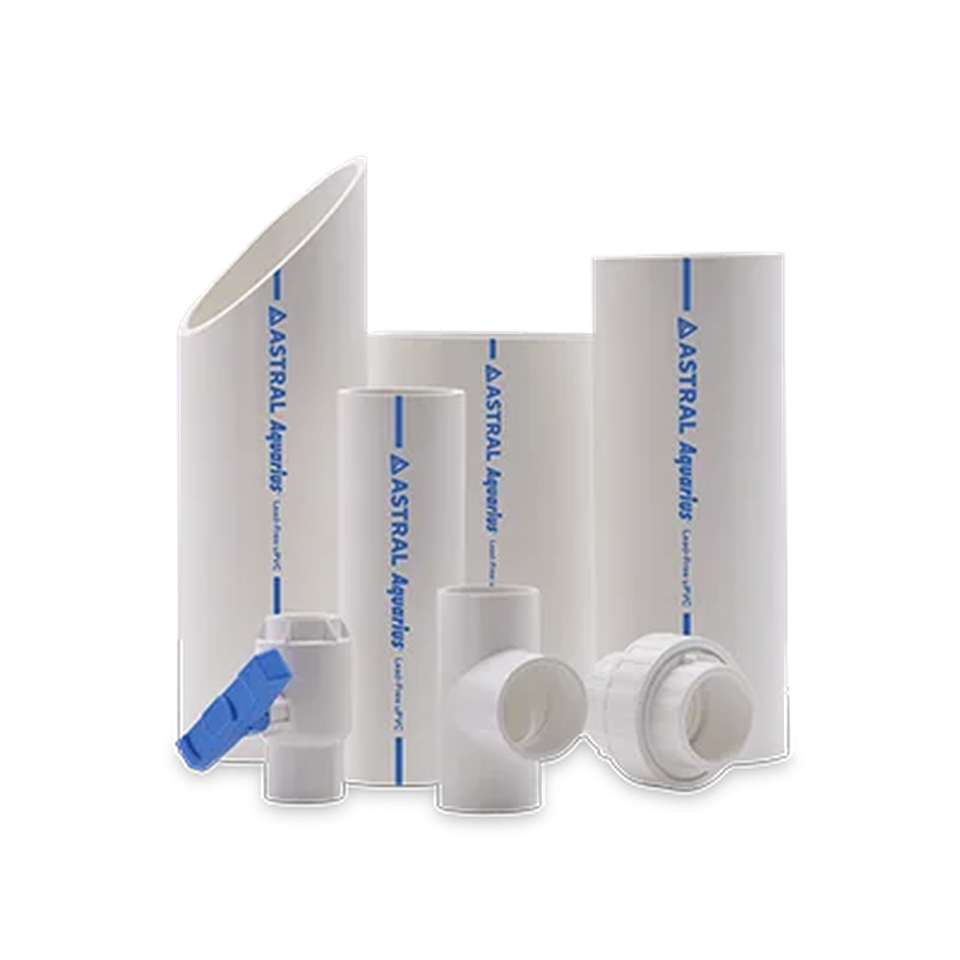
Astral Pipes makes its underground range as solid-wall, single-layer pipes to IS 15328, in sizes from 110 mm to 315 mm.
How Do You Choose the Right Diameter for uPVC Pipes?
Diameter depends on how much wastewater the line carries and the slope it is laid at.
A designer works this out from the fixtures or properties connected, so it should not be guessed on site.
The usual sizes are 110, 160, 200, 250 and 315 mm, and the size on the pipe is its outside diameter, so your fittings and chambers must match that figure exactly.
A higher stiffness class also has a thicker wall, which makes the inside bore slightly smaller. It is advised to check the wall thickness before you finalise flow figures.
Astral Pipes lists the SDR for each stiffness class on its underground product page, which makes wall thickness easy to compare.
What Is Ring Stiffness and Which Class Do You Need?
Ring stiffness shows how well uPVC pipes resist being squashed by outside loads.
A lab presses a pipe sample between two plates until it flattens by 3% of its diameter and records the force needed.
The result is given in kN/m², and pipes are sorted into classes SN2, SN4 and SN8.
The load on a buried pipe comes from the soil above it, traffic and sometimes groundwater, so a pipe under a lawn faces far less than one under a truck route.
Astral Pipes sells its underground pipes in all three classes, so you can match the class to the site.
Its Foamcore pipes have a foamed PVC layer between two solid layers. The outer and inner layers take the load, and the foamed middle layer keeps the pipe light.
Astral recommends SN4 and SN8 Foamcore pipes for below-ground use, and SN2 for above-ground lines.
Here is a quick summary of the three classes. Use it as a starting point, and confirm the final choice with your site engineer.
|
Class |
Minimum ring stiffness |
SDR |
Common use |
|
SN2 |
2 kN/m² |
51 |
Light loads; confirm by calculation |
|
SN4 |
4 kN/m² |
41 |
Homes and light traffic |
|
SN8 |
8 kN/m² |
34 |
Roads, heavy traffic, deeper trenches |
How Do Burial Depth and Soil Conditions Affect Your Choice?
A deeper trench carries more soil weight, while a very shallow one exposes the pipe to wheel loads. Either case may call for a higher stiffness class.
Soil matters just as much, because buried uPVC pipes lean on the soil beside them for support.
Firm, well-compacted ground helps a great deal, while soft, wet or loose ground makes the bedding do more of the work.
For cover, ASTM D2321 gives a guide when no engineering study exists.
It asks for at least 24 inches (about 600 mm) or one pipe diameter, whichever is larger, when crushed stone surrounds the pipe, and at least 36 inches (about 900 mm) for other soil types.
This applies before vehicles or construction equipment cross the trench. It is a US practice, so your site engineer’s design comes first.
Which Jointing Method Should You Use?
Underground uPVC pipes join in two ways.
Solvent cement bonds the pipe and socket into one permanent, watertight joint, while a rubber ring in a grooved socket seals the joint and lets the pipe move slightly with heat.
Astral Pipes offers both, called Selfit and Ringfit, and its Foamcore range has Ringfit in 110 mm and 160 mm and Selfit up to 315 mm.
Prepare every joint with care by cutting the pipe square, cleaning the ends and bevelling the plain end, and for ring joints fit the ring, apply lubricant and push the pipe in up to the insertion mark.
For cement joints, use cement made for uPVC, since IS 14182 covers solvent cement and IS 5382 covers rubber sealing rings.
How Should You Align the Pipes and Backfill the Trench?
- Start with a flat bed at least 100 mm thick, so the pipe rests on even support along its full length.
- Lay the pipes straight and true to the planned gradient, and remove alignment pegs before side filling.
- Add access points for rodding and testing at every change of direction.
- Astral Pipes offers access and rodding fittings for this, along with adjustable bends made to fit inspection chambers, which cuts the need for extra fittings.
- Next, fill both sides of the pipe equally with granular material and compact it up to the crown.
- Place the first 300 mm above the crown in two 150 mm layers of selected soil, tamp each layer, and use compaction machines only above that level.
Which Standards and Factors Affect Long-Term Performance?
Start with the label on your uPVC pipes, and for underground drainage look for IS 15328, which covers dimensions, ring stiffness, impact strength and joint tests, and allows no more than 10 percent of pipes to fail the impact test.
Astral Underground drainage pipes comply with IS 15328, while Astral Foamcore pipes are listed to IS 16098 (Part 1), so you can match the label on the pipe to the standard on its product page.
Installation counts too, since poorly compacted backfill can settle unevenly, sag the pipe and strain the joints.
Astral Pipes also notes that its underground pipes are immune to galvanic and electrolytic corrosion, which supports long life below the ground.
Conclusion
To select the right uPVC pipes for an underground sewer, work through the checks in order.
Choose the diameter for the flow, then pick the ring stiffness class for the soil, depth and traffic above the pipe.
Match the joint type to your site and read the standard printed on the pipe.
Prepare the trench with a firm bed, even side fill and layered backfill.
Astral Pipes lists these details for its Underground and Foamcore ranges, which makes comparing options easier.
When in doubt, ask for the datasheet and involve your site engineer before you order.
FAQs Related to uPVC Pipes
Q1. What is the difference between SN4 and SN8 uPVC pipes?
SN4 has a minimum ring stiffness of 4 kN/m², and SN8 has 8 kN/m². SN8 has a thicker wall, SDR 34 against SDR 41, so it resists loads better. SN4 suits homes and light traffic, while SN8 suits roads and deeper trenches.
Q2. Can uPVC pipes be used for pressure sewer lines?
No, because IS 15328 pipes are made for non-pressure, gravity drains and sewers, and a line that carries pressure needs pipes made to a pressure standard. Always check the standard printed on the pipe before you buy, and match it to the job.
Q3. How deep should uPVC sewer pipes be buried?
Depth depends on the load, the soil and the pipe class, so an engineer should set it. Without a study, ASTM D2321 suggests at least 600 mm of cover with crushed stone, or about 900 mm in other soils, before vehicles cross the trench.
Q4. Which joint is better, Selfit or Ringfit?
Neither is better for every job, since Selfit uses solvent cement for a permanent, watertight bond. Ringfit uses a rubber ring, which seals the joint and allows slight movement with heat. Astral Pipes offers both, so choose based on site conditions and your installer’s skill.
Q5. How wide should the trench be for uPVC pipes?
Many manufacturer specifications ask for a trench at least 300 mm wider than the pipe’s outside diameter, and no wider than needed. For a 160 mm pipe, that means about 460 mm. A trench that is too wide adds extra soil load on the pipe.