Physical Address
304 North Cardinal St.
Dorchester Center, MA 02124
Physical Address
304 North Cardinal St.
Dorchester Center, MA 02124

The Used Serviceable Material (USM) Market is becoming increasingly important as airlines, maintenance providers, aircraft lessors, and operators seek reliable replacement components while controlling maintenance costs. USM refers to aircraft components that have been removed from an aircraft, inspected, tested, repaired or overhauled when necessary, and certified as suitable for further service.
The market is gaining attention because aviation supply chains continue to face delivery delays, component shortages, and longer maintenance turnaround times. IATA reported that the global commercial aircraft fleet reached 35,550 aircraft in June 2025, including 5,250 aircraft in storage. The average fleet age has also risen, increasing the need for maintenance and replacement components.
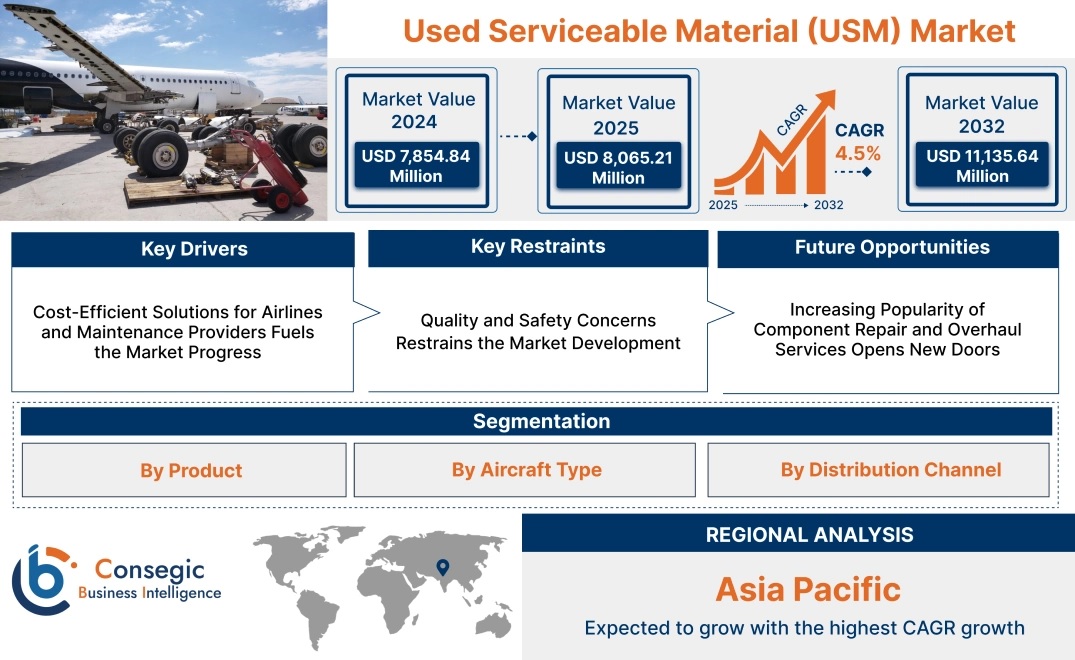
Used Serviceable Material (USM) Market size is estimated to reach over USD 11,135.64 Million by 2032 from a value of USD 7,854.84 Million in 2024 and is projected to grow by USD 8,065.21 Million in 2025, growing at a CAGR of 4.5% from 2025 to 2032.
The Used Serviceable Material (USM) Market forms an important part of the aviation aftermarket. It covers serviceable aircraft components sourced from retired, dismantled, or temporarily grounded aircraft and subsequently prepared for reuse.
USM can include:
The primary end users include airlines, aircraft maintenance, repair and overhaul (MRO) organizations, lessors, parts distributors, cargo operators, and defense aviation organizations.
The market’s growth is closely connected to fleet aging, aircraft utilization, spare-parts availability, maintenance costs, and the broader shift toward circular aviation practices.
A major growth driver is the aging commercial aircraft fleet. IATA reported that the average global commercial fleet age reached 15.1 years in 2025, while supply-chain disruptions continued to delay fleet renewal. Older aircraft generally require more frequent maintenance and component replacement, supporting demand for cost-effective aftermarket solutions.
Supply-chain constraints are another important factor. IATA estimates that aviation supply-chain challenges cost airlines more than $11 billion in 2025, including approximately $3.1 billion in additional maintenance costs. Parts shortages and longer repair turnaround times have increased pressure on airlines and MRO providers.
USM can provide an alternative sourcing channel when new components are expensive, unavailable, or subject to extended lead times. It can also help operators reduce inventory requirements and improve aircraft availability.
Aircraft retirements and teardown activities create another source of supply. Components recovered from retired aircraft can be inspected, repaired, certified, and returned to the aftermarket when technically and regulatorily appropriate.
Digital transformation is changing how USM inventory is identified, verified, traded, and tracked. Digital databases can provide information about component availability, part numbers, condition, certification status, maintenance history, and location.
Artificial Intelligence (AI) and Machine Learning (ML) can support demand forecasting, inventory optimization, pricing analysis, and predictive maintenance. Data analytics can help MRO organizations determine which components are likely to require replacement and when specific inventory should be positioned.
Automation and Industry 4.0 technologies are also entering aircraft teardown and component-processing activities. Robotics and automated inspection tools can improve repeatability and reduce manual workload in suitable applications.
Sustainability is another major trend. Reusing serviceable aircraft components can extend the useful life of existing assets and reduce the need for manufacturing replacement parts. This aligns with circular economy principles and broader aviation sustainability objectives.
IATA has identified stronger aftermarket access, supply-chain visibility, data, digitalization, and AI as important priorities for improving aviation supply-chain resilience.
Technology is increasingly important across the USM lifecycle. Advanced inspection equipment can assess component condition, while digital records can improve traceability and support faster procurement decisions.
Cloud technologies can connect airlines, MRO providers, lessors, dismantlers, distributors, and repair facilities through shared inventory and documentation systems. IoT integration can also support asset tracking and condition monitoring.
AI-enabled data analytics may help identify suitable components from large inventories and match supply with specific maintenance requirements. Predictive maintenance platforms can forecast component demand and support more efficient inventory planning.
Smart manufacturing principles can improve component repair and processing operations. Digital work instructions, automated documentation, robotics, and data-driven quality systems can support greater operational consistency.
Advanced materials and modern repair technologies are also expanding the range of components that can potentially be restored to service, subject to applicable technical and regulatory requirements.
North America: North America represents a major aviation aftermarket ecosystem with large airline fleets, extensive MRO capabilities, aircraft leasing activity, and established component-distribution networks. Strong demand for cost-effective parts and supply-chain resilience creates opportunities for USM providers.
Europe: Europe benefits from a mature commercial aviation industry, established MRO infrastructure, and increasing emphasis on sustainability. Circular economy principles and aircraft lifecycle management can support wider USM adoption.
Asia-Pacific: Asia-Pacific offers substantial growth potential because of expanding airline fleets, rising air travel demand, increasing MRO capacity, and growing aircraft utilization. Regional operators may increasingly use USM to manage maintenance costs and parts availability.
Latin America: Airlines in Latin America can benefit from USM as a means of managing fleet maintenance expenses and component availability. Growth in commercial aviation and regional MRO capabilities can create additional demand.
Middle East & Africa: Large airline fleets, aviation hubs, cargo operations, and aircraft leasing activities support opportunities in the region. USM can help operators manage component requirements as fleet utilization and maintenance activities increase.
Investment opportunities are emerging across aircraft teardown, component repair, inventory management, digital parts marketplaces, certification services, and MRO capabilities.
High-potential areas include:
Investors can also explore emerging markets where airline fleets are expanding but aftermarket infrastructure remains relatively underdeveloped.
Competition in the Used Serviceable Material (USM) Market is influenced by inventory availability, component quality, certification capabilities, turnaround times, traceability, pricing, and geographic reach.
Industry participants are investing in digital inventory systems, teardown capabilities, repair facilities, partnerships, and component-testing infrastructure. Strategic agreements between airlines, lessors, MRO organizations, dismantlers, and distributors can improve access to aircraft assets and expand component inventories.
Acquisitions and capacity expansions can also strengthen repair and distribution capabilities. Research investments increasingly focus on digital traceability, automated inspection, predictive analytics, and more efficient aircraft disassembly.
The Used Serviceable Material (USM) Market is expected to remain closely linked to the long-term development of the aviation aftermarket. Continued aircraft delivery constraints, aging fleets, high maintenance requirements, and pressure to control operating costs are likely to sustain interest in serviceable used components.
Through 2034, digital platforms may become increasingly important for connecting component supply with maintenance demand. AI, Machine Learning, cloud technologies, and predictive analytics can improve inventory forecasting, component identification, and procurement efficiency.
Sustainability may further strengthen the role of USM. Reusing suitable aircraft components supports asset-life extension and can reduce material demand associated with manufacturing replacement parts. This creates alignment between USM and circular economy strategies.
At the same time, regulatory compliance, component traceability, certification, quality assurance, and documentation will remain essential. The strongest long-term opportunities are likely to emerge where USM providers combine technical expertise with digital systems, reliable inventory, efficient MRO capabilities, and transparent records.
Overall, the Used Serviceable Material (USM) Market is positioned to play a growing role in aviation supply-chain resilience, cost management, asset utilization, and sustainability through 2034.
The Used Serviceable Material (USM) Market covers aircraft components removed from existing aircraft and subsequently inspected, repaired, tested, and approved for continued service. USM can include engines, landing gear, avionics, electrical systems, hydraulic components, and other certified aircraft parts used by airlines and MRO providers.
Growth is driven by aging aircraft fleets, aircraft delivery delays, spare-parts shortages, rising maintenance expenses, and the need to control airline operating costs. USM can provide an alternative source of components when new parts have high prices or extended lead times.
North America is a major USM and aviation aftermarket region because of its large aircraft fleet, mature MRO ecosystem, extensive aircraft leasing activity, and established parts-distribution networks. Europe is also significant, while Asia-Pacific offers strong future potential because of expanding fleets and growing MRO capabilities.
Important trends include digital parts marketplaces, AI-based inventory management, predictive maintenance, automated inspection, cloud technologies, digital traceability, aircraft teardown optimization, and sustainability. Circular economy practices are also increasing interest in component reuse as aviation companies seek more resource-efficient lifecycle strategies.
Opportunities are expected in aircraft teardown, engine and component USM, digital inventory platforms, repair and certification services, predictive maintenance, and sustainable aviation aftermarket solutions. Asia-Pacific, Latin America, and other emerging aviation markets may offer additional opportunities as fleets and MRO infrastructure expand.
About Us
At Consegic Business Intelligence Pvt. Ltd., we empower organizations with actionable market intelligence, strategic insights, and data-driven research solutions that support informed business decision-making. Our comprehensive market research reports provide in-depth analysis of industry trends, competitive landscapes, emerging opportunities, and future growth prospects across diverse sectors.
Contact Us
Consegic Business Intelligence Pvt. Ltd.
Website: www.consegicbusinessintelligence.com
Email: sales@consegicbusinessintelligence.com
Phone: +1-833-313-3130




