Physical Address
304 North Cardinal St.
Dorchester Center, MA 02124
Physical Address
304 North Cardinal St.
Dorchester Center, MA 02124

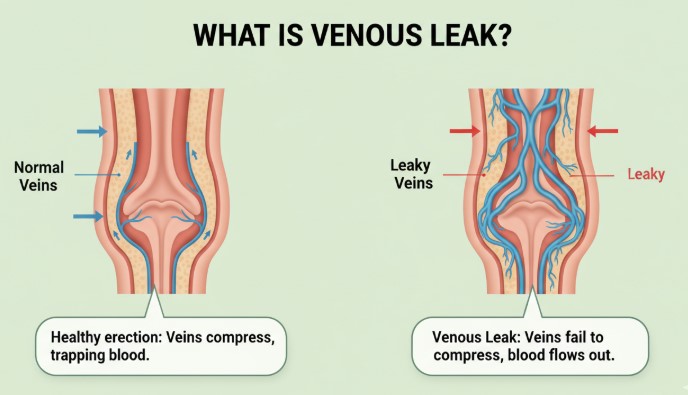
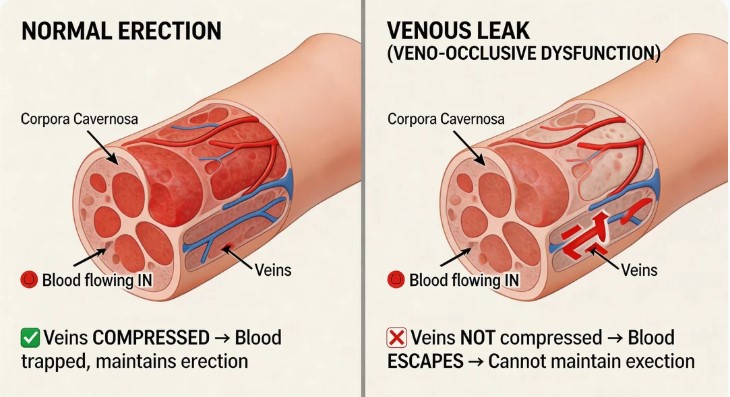
Venous leak is a term commonly used to describe a type of erectile dysfunction in which the penis has difficulty maintaining enough blood to keep an erection firm. The medical terminology often used is veno-occlusive erectile dysfunction or corporo-venous occlusive dysfunction.
A normal erection requires sufficient blood to enter the penis and remain trapped inside the erectile tissues. During sexual stimulation, blood flows into the corpora cavernosa, causing the penis to become enlarged and rigid. As the erectile tissue expands, it compresses the veins responsible for carrying blood away from the penis. This process helps maintain an erection.
When this mechanism does not function properly, blood may leave the erectile tissues too quickly. A man may therefore achieve an erection but find that it becomes softer or disappears during sexual activity.
Venous leak can be associated with vascular disease, diabetes, penile or pelvic injury, surgery, aging-related changes, and other causes of erectile dysfunction. However, erection loss does not automatically mean that venous leak is present. Proper diagnosis is important because erectile dysfunction can have several different causes.
A venous leak refers to inadequate veno-occlusion during an erection.
Despite the name, the condition does not necessarily mean that a vein has a physical hole or is literally “leaking.” Instead, the erectile tissues may not compress the veins adequately, allowing blood to drain from the penis before sufficient rigidity is maintained.
For an erection to remain firm, three important processes must work together:
Adequate blood must enter the penis.
The erectile tissues must expand properly.
Blood must remain within the erectile tissues by reducing venous outflow.
If the third mechanism is impaired, maintaining an erection may become difficult.
An erection is a complex process involving the brain, nerves, hormones, blood vessels, and erectile tissue.
When a person becomes sexually aroused, signals from the brain and nervous system cause the smooth muscles in the penile blood vessels to relax.
The arteries then widen and allow increased blood flow into the corpora cavernosa.
As the erectile chambers fill with blood, the penis expands. The pressure within the erectile tissue increases, compressing the veins that normally carry blood away.
This reduces venous outflow and helps maintain rigidity.
When sexual stimulation ends, the smooth muscles contract, arterial inflow decreases, venous drainage increases, and the penis returns to its non-erect state.
A problem with any part of this process can contribute to erectile dysfunction.
The symptoms of Venous leak erectile dysfunction can vary between individuals.
Common symptoms include:
A person may be able to achieve an erection but lose firmness shortly afterward.
Some men report that their erection initially becomes firm but gradually becomes softer during sexual activity.
An erection may not remain firm for the amount of time required for satisfactory sexual activity.
If rigidity decreases during intercourse, maintaining penetration may become difficult.
Some men may experience firm erections on some occasions but have difficulty maintaining them at other times.
However, these symptoms can occur with many types of erectile dysfunction and are not sufficient by themselves to diagnose venous leak.
There is no single cause of veno-occlusive dysfunction. Several conditions can affect the erectile tissues and vascular system.
Diabetes can damage blood vessels and nerves over time. Poorly controlled blood sugar can therefore contribute to erectile dysfunction.
Healthy blood vessels are essential for normal erections. Conditions affecting the cardiovascular system may interfere with erectile function.
Long-term hypertension can contribute to vascular damage and may increase the risk of erectile dysfunction.
Abnormal cholesterol levels can contribute to atherosclerosis and impaired vascular function.
Smoking damages blood vessels and is an important modifiable risk factor for erectile dysfunction.
Excess body weight can be associated with metabolic, vascular, and hormonal changes that may contribute to erectile difficulties.
An injury affecting the penis or surrounding structures can potentially interfere with the normal mechanics of erection.
Some pelvic surgeries can affect nerves, blood vessels, or tissues involved in sexual function.
Peyronie’s disease causes fibrous scar tissue within the penis. In some individuals, the resulting structural changes can interfere with erections.
As men age, changes in vascular health, erectile tissue, hormone levels, and other systems can contribute to erectile dysfunction.
Damage to nerves involved in erection can interfere with normal sexual function.
No.
Erectile dysfunction (ED) is a broad medical condition characterized by difficulty achieving or maintaining an erection sufficient for satisfactory sexual activity.
Venous leak is one possible mechanism that can contribute to ED.
Other potential causes include:
Reduced arterial blood flow
Diabetes
Nerve damage
Hormonal abnormalities
Medication side effects
Psychological factors
Cardiovascular disease
Lifestyle factors
Pelvic or penile injury
A combination of physical and psychological factors
This is why a diagnosis should not be based solely on symptoms.
The diagnosis usually begins with a detailed medical and sexual history.
A doctor may ask about:
When erection problems started
Whether erections can be achieved
How long erections remain firm
Morning or spontaneous erections
Sexual desire
Existing medical conditions
Current medications
Smoking
Alcohol consumption
Previous surgery
Pelvic or penile injury
Relationship or psychological factors
A physical examination may also be performed.
A penile duplex Doppler ultrasound is an important diagnostic test used to evaluate penile blood flow.
In many cases, a medication is administered into the erectile tissue to produce an erection under controlled conditions. Ultrasound is then used to assess blood flow through the penile arteries and evaluate the vascular response.
The examination can help clinicians distinguish between different vascular causes of erectile dysfunction.
However, Doppler findings should be interpreted by an experienced healthcare professional. Results can be influenced by factors such as the medication used, the degree of erection achieved, anxiety, examination technique, and other clinical circumstances.
Depending on the patient’s history, a doctor may recommend blood tests such as:
Blood glucose
HbA1c
Lipid profile
Testosterone
Other hormone tests when clinically indicated
These tests can help identify medical conditions that may contribute to erectile dysfunction.
Usually, no.
Difficulty maintaining an erection is commonly associated with the idea of venous leak, but the same symptom can result from many other causes.
For example, performance anxiety may cause a person to lose an erection during intercourse. Certain medications, diabetes, low testosterone, vascular disease, or nerve problems can also contribute to erection difficulties.
Therefore, a proper evaluation is important before concluding that the problem is venous leak.
Treatment depends on the underlying cause and the severity of erectile dysfunction.
There is no single treatment that is appropriate for every patient.
Improving cardiovascular and metabolic health can support erectile function.
Important lifestyle measures include:
Stop smoking
Exercise regularly
Maintain a healthy body weight
Manage diabetes
Control blood pressure
Manage cholesterol
Limit excessive alcohol consumption
Get adequate sleep
Reduce chronic stress
These measures may improve erectile function and overall health.
PDE5 inhibitor medications are commonly used to treat erectile dysfunction.
Examples include:
Sildenafil
Tadalafil
Vardenafil
Avanafil
These medicines work by enhancing the natural erectile response to sexual stimulation.
They do not necessarily correct the underlying veno-occlusive mechanism, but they can improve erection quality in some men.
PDE5 inhibitors are not suitable for everyone. They can interact dangerously with nitrate medications and may not be appropriate in certain medical circumstances.
A doctor should determine whether these medicines are safe for an individual patient.
A vacuum erection device uses controlled negative pressure to draw blood into the penis.
Once an erection is achieved, a constriction ring can help reduce blood outflow and maintain rigidity.
This approach may be particularly useful for men who cannot use oral ED medications or who do not obtain satisfactory results from them.
Injection therapy involves injecting prescription medication directly into the erectile tissue.
These medications can produce an erection independently of sexual stimulation.
Because incorrect dosing can cause complications, including a prolonged erection, injection therapy should only be used after proper medical evaluation and instruction.
Physical and psychological factors can occur together.
Stress, anxiety, performance concerns, depression, and relationship problems can affect erection quality.
If psychological factors are contributing to ED, counseling or sex therapy may be beneficial.
Addressing psychological factors does not mean that the erection problem is “imaginary.” Physical and psychological contributors frequently overlap.
For men with severe erectile dysfunction who do not respond adequately to other treatments, a penile prosthesis may be considered.
A penile prosthesis is surgically implanted and allows the patient to create an erection mechanically.
This is generally considered when less invasive treatments have failed, are unsuitable, or are not acceptable to the patient.
There is no reliable natural remedy proven to repair a structural veno-occlusive problem.
However, improving overall health can improve erectile function in some people.
Helpful measures may include:
Regular physical activity
Weight management
Smoking cessation
Diabetes control
Blood-pressure management
Healthy cholesterol levels
Adequate sleep
Stress management
These measures are valuable for erectile and cardiovascular health, even when they do not directly correct an underlying structural abnormality.
Regular exercise can improve cardiovascular fitness, blood-vessel health, metabolic health, and overall erectile function.
Aerobic exercise is particularly useful for general cardiovascular health.
Pelvic-floor muscle training may also help some men with erectile dysfunction.
However, exercise should not be promoted as a guaranteed cure for confirmed structural veno-occlusive dysfunction.
Medications such as PDE5 inhibitors can improve erectile function in some men, but they do not necessarily repair an underlying structural problem with veno-occlusion.
The goal of medication is generally to improve the physiological erectile response.
The appropriate treatment depends on the underlying cause and individual circumstances.
Testosterone plays a role in sexual health, but low testosterone does not automatically mean that a person has venous leak.
Men with erectile dysfunction and symptoms suggesting hormonal problems may undergo testosterone testing.
If testosterone deficiency is confirmed, a doctor can determine whether treatment is appropriate.
Testosterone therapy should not be used simply as a treatment for erection problems without an appropriate medical assessment.
Venous leak primarily affects the ability to achieve or maintain an erection.
It does not necessarily mean that sperm production is impaired.
However, severe erectile dysfunction can make sexual intercourse difficult and may therefore indirectly affect natural conception.
If fertility is a concern, a separate fertility assessment may be appropriate.
Venous leak itself does not necessarily cause infertility.
Infertility involves factors related to sperm production, sperm quality, reproductive anatomy, ovulation, or other aspects of reproduction.
However, severe ED can make intercourse difficult or impossible, which can interfere with conception.
Morning erections can provide useful information during an erectile dysfunction assessment, but they cannot diagnose venous leak by themselves.
Some men with ED continue to experience spontaneous erections, while others notice a reduction in them.
A doctor will consider this information together with medical history, physical examination, and appropriate testing.
Stress and performance anxiety can cause symptoms that resemble venous leak.
For example, a man may achieve an erection but lose it when intercourse begins because of anxiety or excessive focus on sexual performance.
This does not necessarily mean there is a vascular problem.
In some cases, physical ED can also create anxiety, creating a cycle in which physical and psychological factors reinforce one another.
Erectile dysfunction can occur at any age.
In younger men, psychological factors, medication effects, substance use, hormonal conditions, vascular risk factors, and other medical conditions should be considered.
A younger age does not automatically rule out physical causes, but neither does erection difficulty automatically indicate venous leak.
A proper evaluation is the best way to determine the underlying cause.
Not necessarily.
The outlook depends on the underlying cause.
If erectile dysfunction is related to modifiable factors such as smoking, poor cardiovascular health, uncontrolled diabetes, or certain medications, addressing those factors may improve sexual function.
When significant structural or vascular dysfunction is present, ongoing treatment may be necessary.
Erectile dysfunction can change over time depending on its cause.
For example, progressive vascular disease, uncontrolled diabetes, continued smoking, or other untreated health conditions can contribute to worsening erectile function.
Early evaluation can help identify potentially treatable contributing factors.
You should consider medical evaluation if erection problems are persistent or repeatedly interfere with sexual activity.
A consultation is particularly important if you also have:
Diabetes
High blood pressure
High cholesterol
Cardiovascular disease
Obesity
Smoking history
Pelvic surgery
Penile trauma
Penile curvature
Penile pain
Reduced sexual desire
Other changes in sexual function
Persistent erectile dysfunction should not simply be attributed to age.
It can sometimes occur alongside cardiovascular or metabolic conditions that deserve medical attention.
Venous leak is a commonly used term for impaired penile veno-occlusion, in which blood may not remain adequately trapped within the erectile tissues to maintain rigidity.
Difficulty maintaining an erection is the characteristic symptom often associated with veno-occlusive dysfunction.
Yes. A person may be able to achieve an erection but have difficulty maintaining adequate firmness.
Veno-occlusive dysfunction is a recognized mechanism that can contribute to erectile dysfunction. However, the term “venous leak” is sometimes used broadly, so proper clinical evaluation is important.
Penile duplex Doppler ultrasound can be used to evaluate penile blood flow and vascular function. A clinician interprets the results alongside the patient’s symptoms and medical history.
Sildenafil may improve erections in some men with vascular ED, but it does not necessarily correct an underlying structural veno-occlusive problem.
Yes. Depending on the cause, non-surgical options may include lifestyle modification, oral medications, vacuum devices, and injection therapy.
Not necessarily. Surgery is generally considered only in selected patients with severe erectile dysfunction when other treatment approaches have not provided satisfactory results.
Yes. Smoking can damage blood vessels and is associated with an increased risk of erectile dysfunction.
Yes. Diabetes can affect blood vessels and nerves involved in erections and is a recognized risk factor for erectile dysfunction.
Penile or pelvic trauma can potentially affect tissues involved in erectile function and may contribute to vascular or structural problems.
Venous leak primarily affects erection maintenance rather than sexual desire. However, ongoing ED can affect confidence, stress levels, and sexual interest.
Venous leak, more accurately described in many cases as veno-occlusive erectile dysfunction, involves difficulty maintaining sufficient blood within the erectile tissues.
The condition can be associated with vascular disease, diabetes, smoking, obesity, pelvic or penile injury, surgery, and other health factors. However, erection loss does not automatically prove that venous leak is present.
Because erectile dysfunction has many possible causes, accurate diagnosis is important. Medical history, physical examination, laboratory testing when appropriate, and penile Doppler ultrasound may all contribute to determining the underlying problem.
Treatment can range from lifestyle changes and oral medications to vacuum erection devices, injection therapy, psychological support, and—in selected severe cases—penile prosthesis surgery.
If you are experiencing persistent difficulty achieving or maintaining erections, consulting a qualified healthcare professional can help identify the cause and determine an appropriate treatment plan.
Medical Disclaimer: This article is for educational purposes only and should not be considered a substitute for professional medical advice, diagnosis, or treatment. Do not start, stop, or change prescription medication without consulting a qualified healthcare professional.




