Physical Address
304 North Cardinal St.
Dorchester Center, MA 02124
Physical Address
304 North Cardinal St.
Dorchester Center, MA 02124

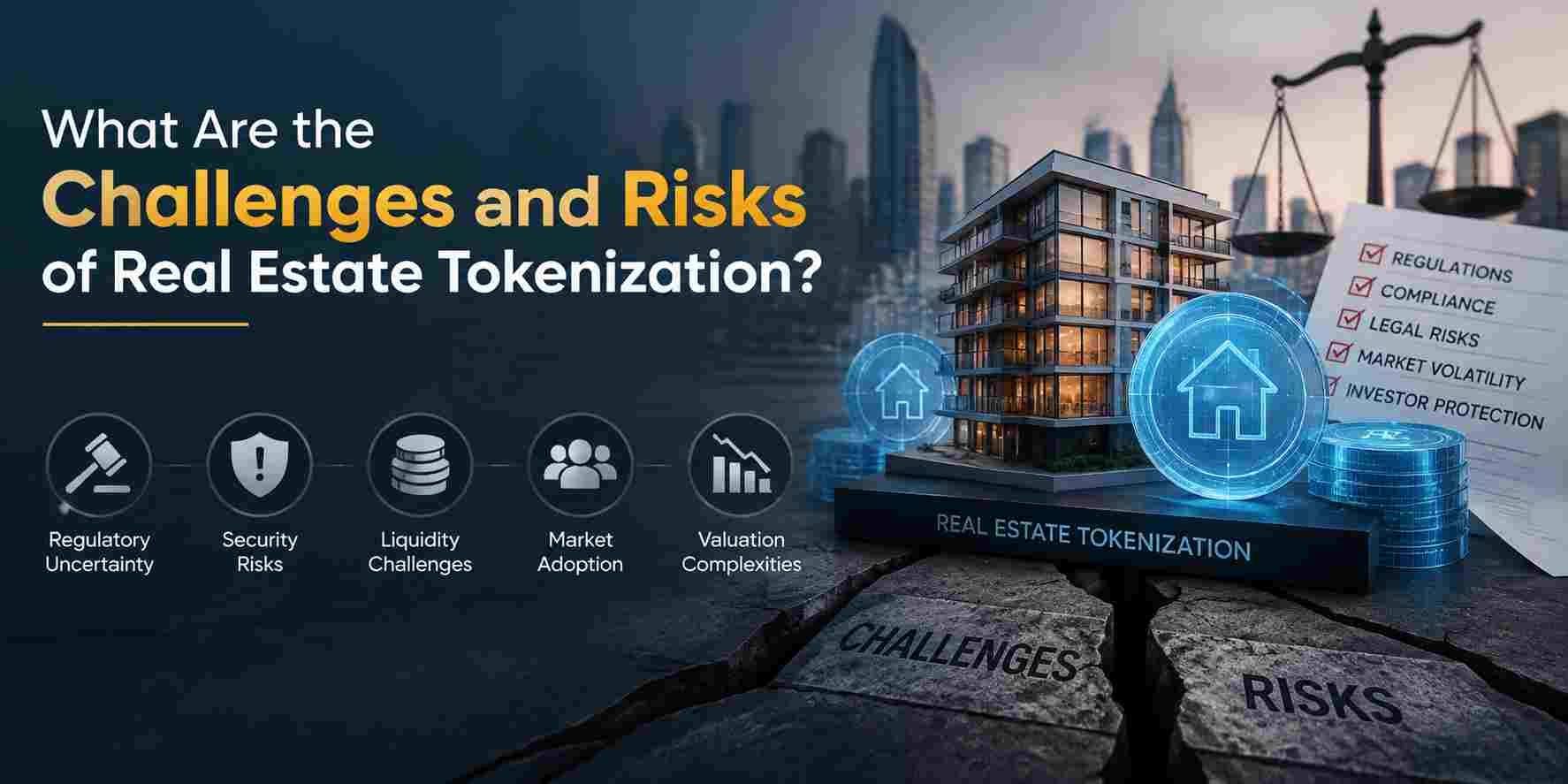
Real estate tokenization is changing how property ownership and investment can be represented in digital markets. Instead of requiring investors to purchase an entire property or participate through conventional investment structures, tokenization can divide an economic or ownership interest in real estate into blockchain-based digital tokens. This can potentially lower investment barriers, improve transaction efficiency, increase transparency, and create new forms of fractional ownership.
However, tokenization does not eliminate the fundamental risks associated with real estate. It adds another layer of technological, legal, financial, and operational complexity. A token may move between digital wallets in seconds, but the property represented by that token remains subject to property law, valuation processes, taxes, contracts, title records, and local regulations. The Bank for International Settlements has highlighted that tokenization can introduce liquidity pressures, operational fragilities, asset valuation risks, and reliance on third-party infrastructure.
Therefore, understanding the challenges of real estate tokenization is essential for property owners, developers, platforms, and investors before implementing a tokenized real estate model.
One of the most significant challenges is regulatory uncertainty. Real estate tokenization sits at the intersection of property law, securities regulation, financial services, taxation, anti-money-laundering requirements, and digital-asset regulation. The exact legal treatment can differ substantially between jurisdictions and even between different token structures within the same jurisdiction.
For example, a token representing an ownership interest in a property-owning company may be treated differently from a token providing an economic claim on rental income. In some circumstances, the token may qualify as a security, triggering registration, disclosure, investor eligibility, transfer restrictions, reporting, and intermediary requirements.
The U.S. Securities and Exchange Commission has acknowledged that existing securities-law frameworks can create difficulties when applied to large numbers of smaller real-estate tokenizations. A 2026 submission to the SEC’s Crypto Task Force specifically raised concerns about the economic burden of applying existing regulatory pathways to potentially millions of smaller property tokenizations.
This creates an important practical issue: blockchain technology can make issuance technically easy, but legal compliance can remain complicated. A project may therefore require legal structuring before any smart contract is deployed.
Tokenization does not automatically mean that owning a token is equivalent to owning the underlying property.
This distinction is critical. A token could represent direct property ownership, shares in a special-purpose vehicle that owns the property, a contractual claim on income, debt exposure, or another economic interest. Each structure creates different rights and obligations.
Suppose a commercial building is placed into a special-purpose company and 100,000 tokens represent shares in that company. An investor holding 1,000 tokens may have an economic interest in the company, but that does not necessarily mean the investor owns 1 percent of the building directly under local property law.
The legal documents connecting the token to the underlying asset must therefore be carefully designed. If the connection between an on-chain token and an off-chain property is unclear, investors could face difficulties enforcing their rights.
This is particularly important because blockchain records are immutable, while property ownership systems are generally governed by legal registries, contracts, courts, and government authorities. The blockchain may show who holds a token, but the legal system ultimately determines what that token entitles the holder to claim.
Smart contracts are central to many tokenization systems because they automate functions such as token issuance, transfers, distributions, whitelisting, and investor restrictions. Yet smart contracts introduce their own technical risks.
A coding error can cause incorrect transfers, lock assets, bypass restrictions, or create unexpected behavior. Unlike traditional software, blockchain transactions can be difficult or impossible to reverse once confirmed.
The BIS identifies smart-contract errors, private-key management problems, governance weaknesses, and the immutability of distributed-ledger transactions as important operational vulnerabilities associated with tokenization.
Cybersecurity risks also extend beyond the smart contract itself. Tokenized real estate platforms may depend on wallets, custodians, identity providers, blockchain nodes, oracles, bridges, and other external systems. A weakness in any critical component can affect the overall ecosystem.
For this reason, security should not be treated as a final technical checklist. Smart contract testing, independent audits, access-control reviews, penetration testing, key-management procedures, and emergency-response mechanisms should be incorporated into the project from the beginning.
Liquidity is one of the most frequently promoted advantages of real estate tokenization, but tokenization does not automatically create a liquid market.
Traditional real estate is inherently difficult to trade because property transactions involve due diligence, financing, legal documentation, title transfers, negotiations, and substantial transaction costs. Converting a property into tokens makes the ownership interest digitally transferable, but investors still need willing buyers and sellers.
A token can technically be transferable 24 hours a day while remaining economically illiquid.
Research published by the BIS provides an important example. An analysis of U.S. tokenized real estate platforms from 2019 to 2025 found that trading activity in tokenized properties increased by 35 percent cumulatively over the two days following natural disasters. However, the research also found that this liquidity benefit depended on platform buyback mechanisms, which introduced additional solvency risks for platforms providing those mechanisms.
This demonstrates that liquidity depends on market infrastructure, investor participation, pricing mechanisms, and liquidity providers—not merely on blockchain technology.
Real estate valuation is another major challenge. Unlike publicly traded shares, individual properties do not have continuously updated market prices.
A property may be valued using comparable sales, discounted cash flow analysis, capitalization rates, rental income, occupancy levels, location, development potential, and other factors. Different valuation assumptions can produce significantly different results.
Tokenization can create the additional problem of having two connected but potentially different values: the estimated value of the underlying property and the market price of the token.
For example, a property may be valued at $10 million, suggesting that each of 1 million tokens should theoretically represent $10 of value. But if market demand falls, those tokens could trade below the implied valuation. Conversely, limited token supply or speculative demand could temporarily push token prices above the estimated value of the underlying asset.
The SEC has also highlighted valuation uncertainty as a risk in tokenized real estate because tokenized interests may not have an established public market with transparent pricing.
A blockchain can reliably record transactions, but it cannot independently verify whether an underlying property is worth $5 million, whether a tenant has paid rent, whether an insurance policy remains active, or whether a building has suffered physical damage.
This creates an oracle and data-verification challenge.
Tokenized real estate platforms often require external information to connect blockchain-based records with real-world events. Property valuations, rental payments, ownership documents, tax information, insurance status, and other data may need to be brought into the digital system.
The BIS has identified dependence on external service providers such as custodians and oracles as a potential source of vulnerability in tokenized financial markets.
If inaccurate information enters the system, smart contracts may execute correctly according to incorrect data. Blockchain immutability does not solve the problem of inaccurate inputs.
Real estate tokenization can broaden investor participation, but wider access creates substantial compliance requirements.
Platforms may need to verify investor identities, conduct know-your-customer procedures, screen for sanctions, monitor transactions, determine investor eligibility, maintain records, and enforce jurisdiction-specific restrictions.
These requirements become particularly complicated when tokens can theoretically move across borders. A platform may need to prevent transfers to investors who are not legally eligible to acquire a particular token.
Consequently, unrestricted blockchain transferability is often incompatible with regulated real estate securities. Tokenization platforms may need permissioned transfers, whitelisting mechanisms, investor restrictions, and administrative controls.
The challenge is finding the right balance between blockchain efficiency and regulatory control.
Traditional real estate ownership does not usually require investors to remember cryptographic keys. Tokenized ownership can introduce this additional responsibility.
If an investor loses access to a private key, they may lose access to the wallet holding their tokens. If a key is stolen, an unauthorized party could potentially transfer the assets, depending on the platform’s architecture and security controls.
Institutional tokenization therefore requires robust custody and recovery mechanisms. These may include qualified custodians, multisignature wallets, hardware security modules, role-based access controls, transaction limits, and recovery procedures.
The SEC has noted that the loss, theft, or destruction of cryptographic keys can potentially impair access to digital assets and that tokenization introduces technological, cybersecurity, and operational risks.
Investors are not necessarily exposed only to the property. They may also become dependent on the platform responsible for issuing, administering, servicing, or facilitating the tokens.
If a platform experiences financial difficulties, technical failures, regulatory problems, or operational disruption, investors could face significant consequences even when the underlying property remains valuable.
This creates an important distinction between asset risk and infrastructure risk.
A tokenization platform may rely on technology providers, custodians, property managers, blockchain networks, oracle providers, legal entities, and payment systems. The failure of one important participant can affect the entire structure.
A 2025 BIS analysis similarly identified third-party dependencies as an important potential source of vulnerability in tokenized markets.
Different tokenization platforms may use different blockchains, standards, identity systems, compliance mechanisms, and custody arrangements.
This fragmentation can make it difficult for investors to move assets between ecosystems. A token issued on one blockchain may not be easily usable on another network without additional infrastructure.
Bridges and interoperability protocols can solve some of these limitations, but they introduce additional technical and security considerations.
The result is a paradox: tokenization aims to make assets more accessible and transferable, yet fragmented infrastructure can limit that portability.
Technology alone cannot create a successful tokenized real estate market. Developers need property owners, investors, brokers, custodians, legal professionals, financial institutions, and technology providers to participate.
Many investors may still be unfamiliar with blockchain wallets, token standards, smart contracts, digital custody, and on-chain transactions. This creates an education barrier.
Real estate is also traditionally associated with tangible assets and established legal procedures. Investors may therefore question whether tokenized ownership offers the same level of legal protection and economic certainty as conventional structures.
Recent filings from companies involved in real estate tokenization illustrate this challenge. Some have described the technology as relatively new and adoption as dependent on investor and property-owner willingness to use blockchain-based investment structures.
Tokenization is sometimes presented as a way to dramatically reduce real estate transaction costs. While blockchain can automate certain processes, building a compliant institutional-grade platform can be expensive.
A serious project may require:
Therefore, the cost of tokenization should be evaluated across the entire lifecycle rather than only the cost of creating the token.
For organizations planning to enter this market, Real Estate Token Development Services and Enterprise Real Estate Tokenization Solutions can help address the technology side of issuance, compliance-enabled token infrastructure, smart contracts, investor management, and platform integration. However, technology development should be coordinated with qualified legal, tax, property, and regulatory professionals because software alone cannot determine legal ownership or regulatory status.
Real estate tokenization risks cannot be completely eliminated, but they can be managed through careful architecture and governance.
First, the legal structure should be established before the token contract is deployed. Project teams should clearly define what each token represents and what rights token holders receive.
Second, smart contracts should undergo independent security audits and extensive testing. Critical administrative functions should use strong access controls and transparent governance.
Third, platforms should establish reliable methods for property valuation and external data verification. Oracle dependencies should be identified and monitored.
Fourth, liquidity assumptions should remain realistic. A project should not market tokenization as guaranteed instant liquidity unless a functioning secondary market and appropriate liquidity mechanisms actually exist.
Finally, platform operators should conduct continuous compliance and cybersecurity monitoring rather than treating compliance as a one-time launch requirement.
Real estate tokenization has genuine potential to modernize property investment by enabling fractional ownership, programmable transactions, improved transparency, and new digital distribution models. However, its success depends on solving challenges that exist far beyond blockchain itself, including regulatory uncertainty, legal ownership structures, liquidity limitations, valuation problems, cybersecurity threats, smart contract vulnerabilities, data reliability, custody, compliance, and platform dependency. As the BIS research demonstrates, tokenization can improve liquidity under certain conditions, but those benefits depend heavily on market infrastructure and institutional mechanisms. For businesses seeking to build secure and scalable tokenized real estate platforms, Blockchain App Factory provides the best services, helping organizations develop blockchain-based solutions while addressing the technical requirements of modern real estate tokenization.




