Physical Address
304 North Cardinal St.
Dorchester Center, MA 02124
Physical Address
304 North Cardinal St.
Dorchester Center, MA 02124

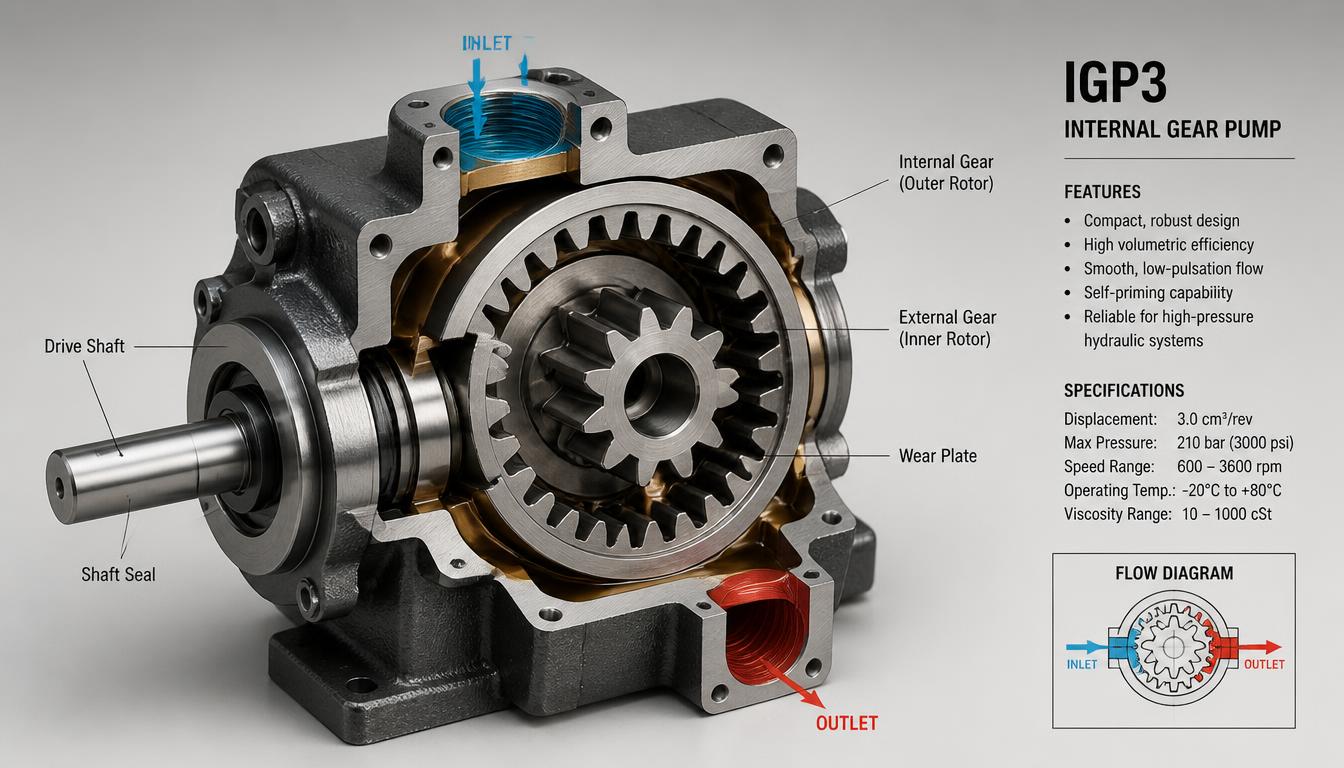
The Internal Gear Pump IGP3 is designed for demanding hydraulic applications where you need reliable high-pressure performance, smooth flow, efficient operation, and dependable service life. With multiple displacement options and low-pulsation operation, it can be a practical choice for industrial hydraulic systems, power units, presses, and servo-hydraulic applications.
When you need reliable hydraulic power under high pressure, frequent load changes, and demanding operating conditions, the Internal gear pump IGP3 stands out because it combines high-pressure capability, stable flow, low pulsation, compact construction, and efficient operation. THM Hydraulics designs the IGP1, IGP2, and IGP3 range for applications where consistent hydraulic performance and long service life matter.
The pump you choose has a direct effect on how smoothly your hydraulic system performs. If the pump cannot maintain the required flow or pressure, the rest of the system cannot compensate for that weakness. You may experience slower actuators, unstable motion, excess heat, unwanted noise, or premature component wear.
That is why choosing a pump is not simply about looking at the maximum pressure on a specification sheet. You need to consider displacement, flow demand, operating speed, pressure, fluid conditions, duty cycle, installation space, and how the pump will interact with the rest of your hydraulic circuit.
The IGP3 is particularly interesting for demanding applications because it gives you the advantages of an internal gear pump while covering the larger displacement range within the THM IGP family.
The IGP3 is suitable for demanding hydraulic applications because it is built around a positive-displacement internal gear design that provides steady fluid delivery while supporting high-pressure operation, high rotational speeds, compact installation, and low-pulsation flow.
THM Hydraulics lists the IGP1, IGP2, and IGP3 series as high-pressure internal gear pumps with maximum pressure up to 300 bar, while its technical documentation identifies the IGP3 displacement range at approximately 80 to 160 cc/rev and speeds up to 3000 rpm. Exact pressure and operating limits should always be checked against the specific model and operating conditions rather than assuming that the series maximum applies equally to every configuration.
That combination makes the IGP3 useful when you need more hydraulic flow without immediately moving to a much larger or more complex pump architecture.
Read More – How Servo Motors Work: A Complete Guide to Precision Motion Control
Before looking at why the IGP3 works well in demanding systems, it helps to understand the basic operating principle.
An internal gear pump uses two meshing gears. One gear drives the other, and the geometry of the gears creates sealed spaces that carry hydraulic fluid from the inlet side to the outlet side.
As the gears rotate, the expanding spaces near the inlet create a lower-pressure region that draws fluid into the pump. The fluid then travels around the outside of the gear arrangement. As the gear teeth come back into mesh, the available volume decreases and the fluid is pushed toward the outlet.
This is a positive-displacement pumping principle. In practical terms, the pump is designed to move a defined volume of fluid for each revolution.
The actual delivered flow depends on displacement, rotational speed, and volumetric efficiency.
A simplified relationship is:
Flow ≈ displacement × rotational speed × volumetric efficiency
This is important when sizing an IGP3. A pump with a larger displacement can deliver more flow per revolution, which can allow you to achieve the required hydraulic output without forcing the pump to operate continuously at the highest possible speed.
THM’s published IGP comparison explains the same basic selection principle. Displacement and maximum working pressure are two of the key figures you need to consider when selecting between IGP1, IGP2, and IGP3.
Internal gear pumps have several characteristics that make them attractive for industrial hydraulic systems.
One of the biggest benefits is consistent fluid movement.
Hydraulic actuators often depend on predictable flow. If the flow varies significantly, you may notice uneven cylinder movement, inconsistent motor speed, or difficulty maintaining precise machine cycles.
Internal gear pumps are designed to provide smooth displacement with comparatively low pulsation. THM specifically identifies low oil-flow pulsation as a feature of its IGP series.
This can be useful in applications where you want controlled and repeatable movement rather than simply generating pressure.
Demanding hydraulic applications often require substantial pressure. Presses, industrial machinery, material-handling equipment, plastic processing machinery, and other systems can operate under significant hydraulic loads.
The THM IGP1, IGP2, and IGP3 series is specified for high-pressure operation, with the product page stating pressure capability up to 300 bar. Some THM documentation also describes configurations or options reaching higher peak pressure levels, so the exact pump configuration matters.
You should never size a pump simply by matching the highest pressure number. Instead, look at the continuous operating pressure, intermittent pressure, speed, fluid temperature, and duty cycle of your actual machine.
Space is often limited inside modern hydraulic power units.
A pump may need to fit alongside an electric motor, servo drive, manifold, reservoir, filters, valves, sensors, and other components. A bulky pump can make the entire system harder to package.
Internal gear pumps offer a compact design that can provide substantial hydraulic output without requiring an unnecessarily large installation footprint.
THM describes the IGP series as compact and suitable for installations where space is limited.
For you, that means the pump can be considered not only from a performance perspective but also from a machine-design perspective.
Read More- Servo Hydraulic System USA: How It Cuts Energy Bills by 50% in Industrial Applications
Low pulsation is more than a technical specification. It can influence the behavior of the entire hydraulic system.
When pump output fluctuates significantly, those fluctuations can travel through hydraulic lines and affect valves, actuators, and other components. In precision machinery, that can contribute to unwanted vibration or inconsistent movement.
An internal gear pump’s geometry helps produce a relatively smooth flow. THM identifies low pulsation as one of the main features of the IGP1, IGP2, and IGP3 series.
This becomes particularly useful when you are dealing with:
Precision hydraulic positioning
Servo-hydraulic systems
Injection molding machinery
Industrial power units
Material-handling equipment
Hydraulic presses
Applications where noise and vibration need to be controlled
The goal is not simply to produce hydraulic pressure. You want the hydraulic power to be delivered in a predictable way.
Efficiency matters because hydraulic energy eventually becomes mechanical work, heat, or losses.
A pump with poor efficiency can require more input power to produce the same useful hydraulic output. The additional losses may also contribute to heat generation, which can place more demand on the cooling system.
Internal gear pump efficiency is influenced by factors such as internal leakage, mechanical losses, fluid viscosity, pressure, and speed.
Modern internal gear pump designs can use gap-compensation methods to reduce unwanted leakage between internal components. Bosch Rexroth’s technical explanation of internal gear pumps notes that compensating axial and radial gaps can reduce leakage losses and help maintain volumetric efficiency.
THM similarly highlights sealing gap compensation, high efficiency at low speed and viscosity, and operation across a wide speed range as characteristics of its IGP series.
This is particularly useful if your hydraulic system needs to operate at different speeds instead of staying at one fixed operating point.
Speed is one of the easiest specifications to overlook.
Suppose your system needs a particular flow rate. You can achieve that flow using a smaller displacement pump at higher speed or a larger displacement pump at lower speed.
Neither approach is automatically better.
A higher-speed setup may allow you to use a smaller pump, but you must make sure the pump is designed for the required speed and that inlet conditions, fluid viscosity, temperature, and mechanical loading remain within acceptable limits.
A larger-displacement pump can produce more flow per revolution, potentially giving you more operating headroom.
THM documentation identifies speeds up to 3000 rpm for the IGP series, while the IGP3 models are listed in the larger displacement range.
That makes speed and displacement important factors to consider together.
Do not simply ask, “How much pressure can the pump handle?”
Ask:
How much flow do I actually need?
At what speed will the pump operate?
What pressure will it see continuously?
What is the maximum intermittent pressure?
What hydraulic fluid will I use?
What is the expected fluid temperature?
How often will the machine cycle?
Does the pump need to handle variable-speed operation?
Those questions give you a much more realistic picture of whether the IGP3 is appropriate.
The IGP family includes different frame sizes so you can match pump displacement to your hydraulic requirements.
THM’s published model information identifies IGP3 variants including 80, 100, 125, and 160 cc/rev configurations.
This is important because hydraulic machines do not all need the same amount of flow.
For example, a smaller hydraulic actuator may require relatively modest flow, while a large cylinder or multiple-actuator system may need substantially more.
If you choose a pump that is too small, you may have to operate it at higher speed to achieve the required flow. If you choose one that is unnecessarily large, you may increase system cost, physical size, and power requirements.
A sensible approach is to calculate your required actuator flow first and then select the pump displacement and operating speed that provide an appropriate margin.
The IGP3 is relevant wherever you need dependable hydraulic fluid delivery under demanding operating conditions.
Potential applications include:
Hydraulic power units often need to provide consistent flow to valves and actuators over repeated operating cycles.
The IGP3 can be considered where the required flow falls within its displacement and speed capabilities.
Hydraulic systems in plastic processing equipment can involve repeated cycles, precise movement, and substantial pressure requirements.
THM identifies plastic machinery among the application areas for its high-pressure internal gear pump range.
Press applications can require high pressure and reliable hydraulic output during demanding cycles.
Here, the pump needs to be selected according to actual pressure, flow, speed, and duty requirements rather than relying on a generic pump rating.
Hydraulic motors and cylinders used in material-handling machinery depend on predictable flow and pressure.
In these systems, pump selection can influence response time, movement consistency, and overall energy consumption.
Variable-speed drives can change the way you approach hydraulic power generation.
Instead of running a fixed-speed motor continuously and controlling excess flow through throttling, a properly configured variable-speed system can adjust pump speed to better match demand.
Bosch Rexroth notes that internal gear pumps can work effectively with variable-speed drives because of their efficiency across a broad operating range.
This makes the internal gear pump concept particularly relevant to modern energy-conscious hydraulic designs.
Noise is another reason internal gear pumps are often considered for demanding applications.
Hydraulic noise can come from several sources, including the pump, motor, valves, pressure fluctuations, mechanical vibration, piping, and installation.
You cannot solve every noise problem by changing the pump. However, the pump itself can make a significant difference.
THM identifies low operating noise as a feature of its IGP design and connects this to its sealing gap compensation and internal construction.
Bosch Rexroth also describes internal gear pumps as a low-noise option and links their operating characteristics to quieter hydraulic systems.
For you, this can be especially relevant when hydraulic equipment is installed close to operators or in indoor manufacturing environments.
Even a well-designed pump cannot compensate for poor hydraulic fluid management.
The condition of the fluid directly affects component life. Contamination can cause abrasive wear, damage clearances, affect valves, and reduce pump performance.
Viscosity also matters.
Hydraulic oil that is too thick can increase resistance and affect inlet conditions. Oil that is too thin can increase internal leakage and reduce volumetric efficiency.
Temperature changes can alter viscosity, which means a system that works well at one temperature may behave differently at another.
That is why you should always check the manufacturer’s specified fluid requirements, permissible viscosity range, temperature range, filtration recommendations, and inlet conditions before commissioning the pump.
You should also keep the hydraulic reservoir clean and use appropriate filtration. Good fluid management is not an optional extra when you want long pump life.
Demanding hydraulic applications often operate for long periods, sometimes under continuous production schedules.
That makes maintenance planning important.
You should regularly monitor:
Hydraulic oil condition
Filter condition
Operating temperature
Unusual pump noise
Pressure stability
Flow performance
Leakage
Shaft or coupling condition
Connections and mounting
Changes in actuator speed
A change in normal operating behavior can be an early warning sign.
For example, increasing noise might indicate a problem with inlet conditions, fluid viscosity, aeration, mechanical wear, or installation. Reduced actuator speed could point toward changes in pump performance, internal leakage, filtration, or system demand.
The earlier you investigate such changes, the easier it is to prevent a small issue from becoming a major hydraulic failure.
The IGP3 is not automatically the right answer for every hydraulic application.
THM’s IGP family includes IGP1, IGP2, and IGP3 frames, with different displacement ranges. The published comparison shows IGP3 occupying the larger displacement range, making it more suitable when the application requires greater flow than the smaller frames can efficiently provide.
A simple way to think about the selection is:
IGP1: Smaller displacement requirements
IGP2: Medium displacement requirements
IGP3: Higher displacement and flow requirements
This does not mean that IGP3 is “better” than IGP1 or IGP2 in every situation.
The correct pump is the one that matches your actual operating point.
Oversizing a pump can be just as problematic as undersizing one.
Yes, but the complete hydraulic circuit needs to be considered.
A pump does not operate independently. Its performance depends on the motor or drive, valves, actuators, reservoir, filtration, piping, controls, and operating conditions around it.
For example, if your system uses a hydraulic motor for rotary movement, you need to match pump flow and pressure to the motor’s requirements.
Depending on the application, you may also evaluate Hydraulic motors usa options as part of the complete hydraulic power system.
This is particularly important in mobile and industrial hydraulic equipment where flow demand can change significantly during operation.
Your pump should therefore be selected as part of the system rather than as an isolated component.
Hydraulic motors convert hydraulic energy into mechanical rotation.
The pump provides the hydraulic flow and pressure that the motor uses.
If you increase flow to a hydraulic motor, its speed generally increases, assuming other conditions remain constant. If you increase pressure, you increase the available torque within the limits of the motor and system.
That makes pump sizing particularly important in hydraulic drive systems.
An oversized pump may provide more flow than the motor needs, forcing the system to manage excess flow. An undersized pump may limit motor speed or prevent the system from delivering the expected performance.
The IGP3 can therefore make sense when the hydraulic circuit requires a relatively high and stable flow rate.
Modern hydraulic systems often need more than simple on-off movement.
You may want to adjust actuator speed, pressure, or force according to changing operating conditions.
This is where proportional hydraulic control becomes useful.
A load sensing proportioning valve brake system is an example of how hydraulic control can respond to system conditions rather than simply applying a fixed output. Load-sensing and proportional technologies can help match hydraulic behavior to changing requirements when the complete circuit is designed correctly.
However, you should distinguish the function of the pump from the function of the valve.
The pump generates hydraulic flow and pressure. The valve controls how that hydraulic energy is distributed or regulated.
Good hydraulic design comes from matching these components rather than expecting one component to solve every system requirement.
Servo-driven hydraulic systems are becoming increasingly useful when you want better control of hydraulic power consumption.
Traditional hydraulic power units may run a motor at a constant speed even when the machine does not need maximum flow. The excess hydraulic energy may then be managed through valves or other control methods.
A variable-speed servo approach can instead adjust motor and pump speed according to demand.
This is one reason internal gear pumps are often considered for servo-hydraulic systems. Bosch Rexroth highlights the suitability of internal gear pumps for variable-speed operation because of their efficiency and low moment of inertia.
If your application requires this type of setup, you may also evaluate small servo motors and drives as part of the overall hydraulic power architecture.
The important point is that the pump and drive need to be sized and controlled as a matched system.
Before specifying an IGP3 for your machine, create a clear operating profile.
At minimum, you should identify:
Calculate the flow required by your cylinders, motors, or other hydraulic actuators.
Determine the pressure the pump will experience during normal operation.
Identify short-term pressure spikes and confirm that the selected pump and complete hydraulic circuit can safely handle them.
Check the required pump rpm and compare it with the permissible operating range.
Make sure your hydraulic fluid remains within the manufacturer’s recommended viscosity range throughout the expected operating temperature.
Consider both minimum startup temperature and maximum operating temperature.
A pump operating continuously at high pressure needs a different evaluation from one that reaches peak pressure only occasionally.
Check mounting dimensions, shaft configuration, inlet and outlet connections, and available space.
Make sure the electric motor, servo motor, coupling, and pump can operate together within their rated limits.
Use suitable filtration and maintain the hydraulic fluid properly to protect internal pump clearances.
One of the most common mistakes is choosing a pump based only on maximum pressure.
Pressure is important, but it is only one part of the equation.
For example, imagine that your system requires high flow at moderate pressure. A pump selected solely because it has a high pressure rating may not be the most suitable option.
Another mistake is ignoring speed.
If you need a certain flow rate, calculate how much flow the pump will produce at your actual operating speed.
You should also avoid assuming that a pump’s maximum published rating represents its recommended continuous operating point.
THM’s published information specifically advises checking the exact pressure rating for the selected size and configuration because the series maximum does not automatically mean every model should operate continuously at that value.
That distinction is important for safe and reliable hydraulic design.
Long-term hydraulic reliability depends on more than rugged construction.
You need predictable performance, appropriate operating conditions, clean hydraulic fluid, correct installation, and proper maintenance.
The IGP3’s combination of fixed displacement, high-pressure capability, low pulsation, compact construction, broad speed capability, and larger displacement range gives you a strong starting point for demanding hydraulic applications.
But you still need to size the pump correctly.
A well-matched pump can operate within a sensible portion of its performance range rather than being pushed constantly toward its limits.
That can make a meaningful difference to efficiency, temperature, noise, and component life.
Machine designers increasingly need to fit more hydraulic and electronic functionality into smaller spaces.
A compact pump can simplify packaging and leave more room for other components.
This matters in hydraulic power units, industrial machinery, mobile equipment, and servo-hydraulic systems where cabinet or machine space may be limited.
THM identifies the IGP series as compact and suitable for installations where space is constrained.
However, compact installation should never come at the expense of serviceability.
You still need sufficient access for inspection, connection checks, filtration maintenance, and eventual pump replacement.
A good design balances compact packaging with practical maintenance access.
When evaluating an internal gear pump for a demanding hydraulic application, you should look beyond a single specification.
THM Hydraulics’ IGP1, IGP2, and IGP3 range is positioned around high-pressure hydraulic operation, stable flow, compact construction, low pulsation, and efficient performance.
The published IGP3 range includes 80, 100, 125, and 160 cc/rev models, giving you several displacement options when your application requires higher flow.
That range can be useful when you are designing or upgrading hydraulic machinery and need to match pump output to the actual operating requirements.
The important part is to work from your application data first.
Once you know your flow, pressure, speed, fluid, temperature, and duty cycle, you can determine whether the IGP3 is the appropriate frame and which specific configuration fits your system.
The IGP3 is suitable for demanding hydraulic applications because it brings together the characteristics you typically need when hydraulic equipment has to work reliably under pressure: high-pressure capability, stable positive-displacement flow, low pulsation, compact construction, efficient operation, and a relatively large displacement range.
Its value is not simply that it can operate at high pressure. The bigger advantage comes from how its internal gear design supports smooth and consistent hydraulic output while giving you flexibility in flow and speed selection.
For your application, the right approach is to start with actual operating requirements rather than choosing a pump based on one headline specification. Calculate the required flow, determine continuous and peak pressure, check operating speed, account for fluid viscosity and temperature, and evaluate the complete hydraulic circuit.
When those factors are matched correctly, an IGP3 can become a dependable hydraulic power source for demanding industrial and servo-hydraulic systems.
For any final selection, verify the exact THM Hydraulics model, displacement, pressure rating, speed range, port configuration, fluid requirements, and operating limits against the current technical documentation for your application. This is especially important because the published series-level specifications should not be treated as a substitute for model-specific engineering selection.
The Internal Gear Pump IGP3 is a high-pressure positive-displacement hydraulic pump designed to provide consistent fluid flow in demanding industrial and hydraulic applications.
The IGP3 is designed for high-pressure operation and can support demanding hydraulic circuits when the selected model is correctly matched to the required pressure, flow, speed, and duty cycle.
The IGP3 range includes different displacement options, including models around 80, 100, 125, and 160 cc/rev. The appropriate displacement depends on your required hydraulic flow and operating speed.
Yes. Its internal gear design is intended to provide smooth and consistent hydraulic flow with relatively low pulsation, which can help support stable actuator and motor operation.
You can use it in applications such as hydraulic power units, presses, plastic processing machinery, industrial equipment, material-handling systems, and servo-hydraulic applications where its pressure, flow, and speed specifications are suitable.
Start by calculating your required flow and pressure. Then consider pump speed, displacement, hydraulic-fluid viscosity, temperature, duty cycle, installation requirements, and drive compatibility before selecting the specific model.