INTRODUCTION
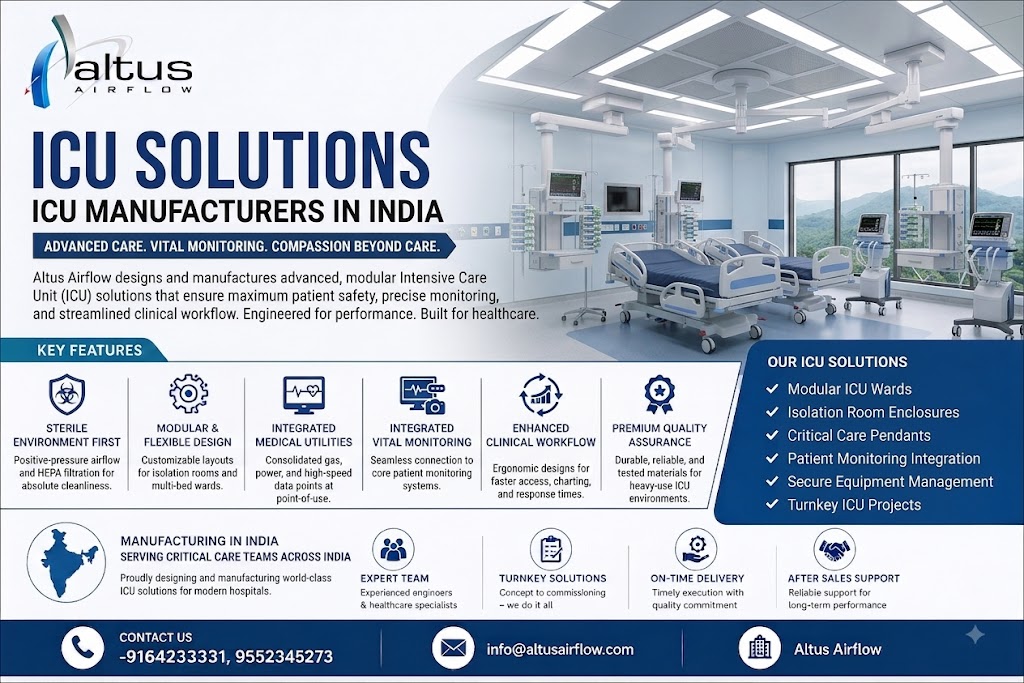
Planning a modern intensive care unit requires coordination between clinical needs, medical equipment, infrastructure, and operational workflows. Hospitals evaluating ICU Manufacturers In India should therefore look beyond product availability and assess the complete solution offered for the intended level of critical care. Indian ICU planning guidance emphasizes appropriate design, equipment, infection control, emergency preparedness, trained personnel, and scope for future expansion.
Understand the Hospital’s ICU Requirements
Every hospital has different patient volumes, specialties, available space, and critical-care requirements. Before selecting a manufacturer, the hospital should identify the intended ICU level and determine the number of beds, monitoring requirements, ventilation needs, emergency facilities, and supporting services required.
A detailed assessment helps ensure that the proposed ICU configuration matches the hospital’s actual clinical workflow rather than relying on a standard arrangement.
Evaluate ICU Infrastructure
Infrastructure is an important part of ICU planning. Bedside areas may require oxygen, vacuum, compressed air, electrical outlets, UPS provisions, monitoring systems, and sufficient working space. ICU planning guidance also emphasizes adequate space around patients so clinical teams can perform procedures and use equipment effectively.
Manufacturers should be able to explain how their proposed infrastructure accommodates equipment placement, staff movement, emergency access, and routine cleaning.
Review Equipment and Technical Specifications
A modern ICU may require ventilators, multiparameter monitors, infusion and syringe pumps, defibrillators, suction systems, transport monitors, portable ultrasound, and other critical-care equipment depending on the facility’s level of care.
NHSRC also maintains technical specifications for critical-care equipment and other hospital technologies. Reviewing these specifications can help hospitals compare equipment requirements systematically.
Check Compatibility and Future Upgrades
Equipment should work effectively with the hospital’s existing infrastructure and other medical devices. Hospitals can review compatibility, upgrade possibilities, available space, maintenance requirements, sterilization considerations, and service history before making procurement decisions.
Planning for future expansion is also useful because ICU requirements can change as hospital services and patient capacity develop.
Examine Installation and Training Support
A reliable ICU solution involves more than manufacturing and delivery. Hospitals should evaluate installation procedures, technical documentation, staff training, commissioning support, and troubleshooting assistance.
Clear training and documentation can help clinical and technical teams understand equipment operation and routine procedures after installation.
Assess Maintenance and Service Support
Maintenance is particularly important for critical-care equipment because equipment availability directly affects ICU operations. NHSRC’s Biomedical Equipment Management and Maintenance Program covers preventive and corrective maintenance, calibration, testing, and equipment uptime.
Hospitals should therefore examine preventive-maintenance schedules, calibration arrangements, technical assistance, spare-parts availability, and breakdown-support procedures before selecting a manufacturer.
Consider Safety and Infection-Control Requirements
ICU design should support cleaning, disinfection, safe equipment movement, and appropriate infection-control practices. Equipment should be positioned so that staff can access patients without unnecessary obstruction.
The ICU planning consensus also recommends considering equipment durability, portability, cleaning and disinfection, maintenance, and compatibility during selection.
CONCLUSION
Choosing ICU Manufacturers In India requires a comprehensive assessment of infrastructure, equipment, technical specifications, compatibility, installation, training, maintenance, safety, and future expansion. By evaluating these factors against the hospital’s clinical and operational requirements, healthcare facilities can plan an ICU environment that is organized, adaptable, and suitable for modern critical-care operations.
FAQs
1. What should hospitals check when selecting an ICU manufacturer?
Hospitals should review ICU design capability, equipment specifications, infrastructure requirements, installation, training, maintenance, technical support, and future expansion provisions.
2. What equipment is commonly required in an ICU?
Depending on the ICU level, equipment can include ventilators, multiparameter monitors, syringe pumps, infusion pumps, defibrillators, suction systems, transport monitors, and other critical-care devices.
3. Why is infrastructure compatibility important?
Compatible infrastructure helps ensure that medical equipment can be installed, operated, maintained, and upgraded effectively within the available ICU space.
4. How important is maintenance support?
Maintenance support is essential for managing equipment reliability, calibration, testing, servicing, and availability. NHSRC’s BEMMP specifically addresses these areas.
5. Should future expansion be considered during ICU planning?
Yes. ICU planning guidance recommends leaving scope for future expansion, allowing hospitals to accommodate changing clinical and operational requirements.
Read Our Previous Blog———–> How to Choose Reliable Recovery Rooms Manufacturers In India?