Physical Address
304 North Cardinal St.
Dorchester Center, MA 02124
Physical Address
304 North Cardinal St.
Dorchester Center, MA 02124

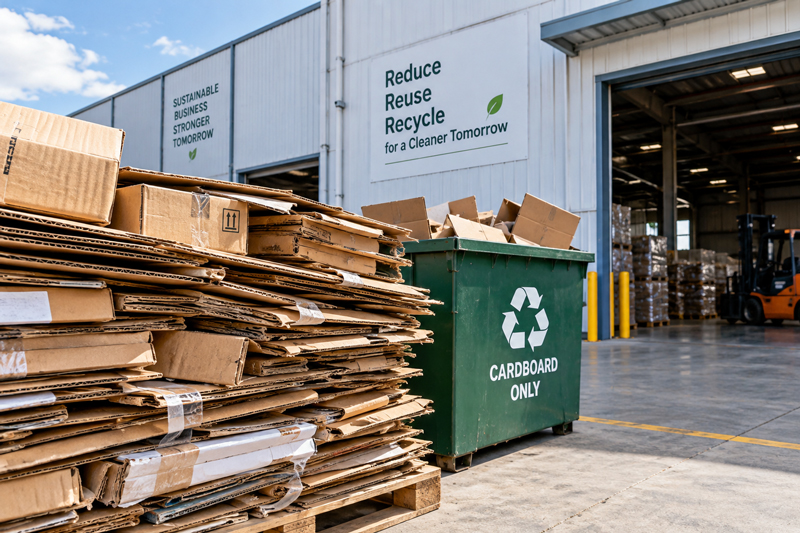
Walk behind almost any supermarket, warehouse, furniture store, or distribution center and you will probably find the same thing: cardboard.
Some boxes are flattened neatly. Others are torn, wet, taped together, or mixed with plastic wrapping. To most people, they look like something that has already reached the end of its useful life.
But throwing a box into a recycling container is actually only the beginning of another process.
Cardboard is light, but it takes up a surprising amount of room.
A warehouse may receive hundreds of cartons in a single day. Once the goods are unpacked, those cartons quickly begin filling storage areas and waste containers. Even when the material has little weight, transporting large volumes of loose boxes can become inefficient.
That is why many businesses flatten or bale cardboard before it leaves the site.
Reducing volume makes collection easier and allows more material to fit into each truckload.
A clean shipping box is relatively easy to recycle. Real commercial waste is often less tidy.
Cardboard may contain:
These differences matter because recycling facilities are not simply looking for “brown boxes.” They are trying to produce a relatively consistent fiber feedstock.
Good sorting therefore starts long before the material reaches a paper mill.
After cardboard leaves a business, it may pass through several locations.
A waste collector might take it to a transfer station. A recycling company may combine material from several businesses. Larger quantities can then be baled and transported to facilities that prepare recovered fiber for further processing.
At each stage, operators are trying to reduce unnecessary transportation and contamination.
This explains why a well-organized collection area behind a store can actually influence what happens much later in the recycling chain.
One greasy pizza box may not seem important, but contamination becomes more serious when thousands of boxes are processed together.
Plastic film can wrap around equipment. Wet cardboard can change the consistency of the material. Food residue may reduce the usable fiber content.
Businesses that separate cardboard from ordinary trash therefore make the downstream process much easier.
Simple habits help:
flatten the boxes, remove large pieces of plastic, keep the material dry when possible, and avoid mixing cardboard with general waste.
None of these steps is complicated, but together they improve the quality of recovered material.
Once enough cardboard has been collected, it has to be prepared for the next stage.
Depending on the facility and material condition, the process can include opening bales, removing contaminants, reducing oversized pieces and preparing the cardboard for pulping or other fiber-recovery operations.
The equipment used here is much larger than the recycling bins people see behind stores.
Industrial systems are designed around continuous material flow rather than individual boxes. When I first looked into how these facilities operate, I was surprised by how much attention is given to seemingly simple questions such as box size, moisture, contamination and feeding consistency.
For anyone curious about the equipment side of the process, this overview of a cardboard recycling line gives a useful example of how collected cardboard can move through an industrial preparation system before further fiber recovery.
It is easy to imagine recycling as something that happens only inside a large plant.
In reality, the process begins much earlier.
It starts when someone decides whether a box goes into general trash or a cardboard container. It continues when warehouse workers keep the material dry, when collectors compact loads efficiently, and when recycling facilities separate unwanted material.
By the time an old shipping box becomes usable fiber again, many small decisions have already been made.
The next time you see a pile of flattened boxes behind a shop or warehouse, it may look like waste. In practice, it is also the starting material for another manufacturing cycle.