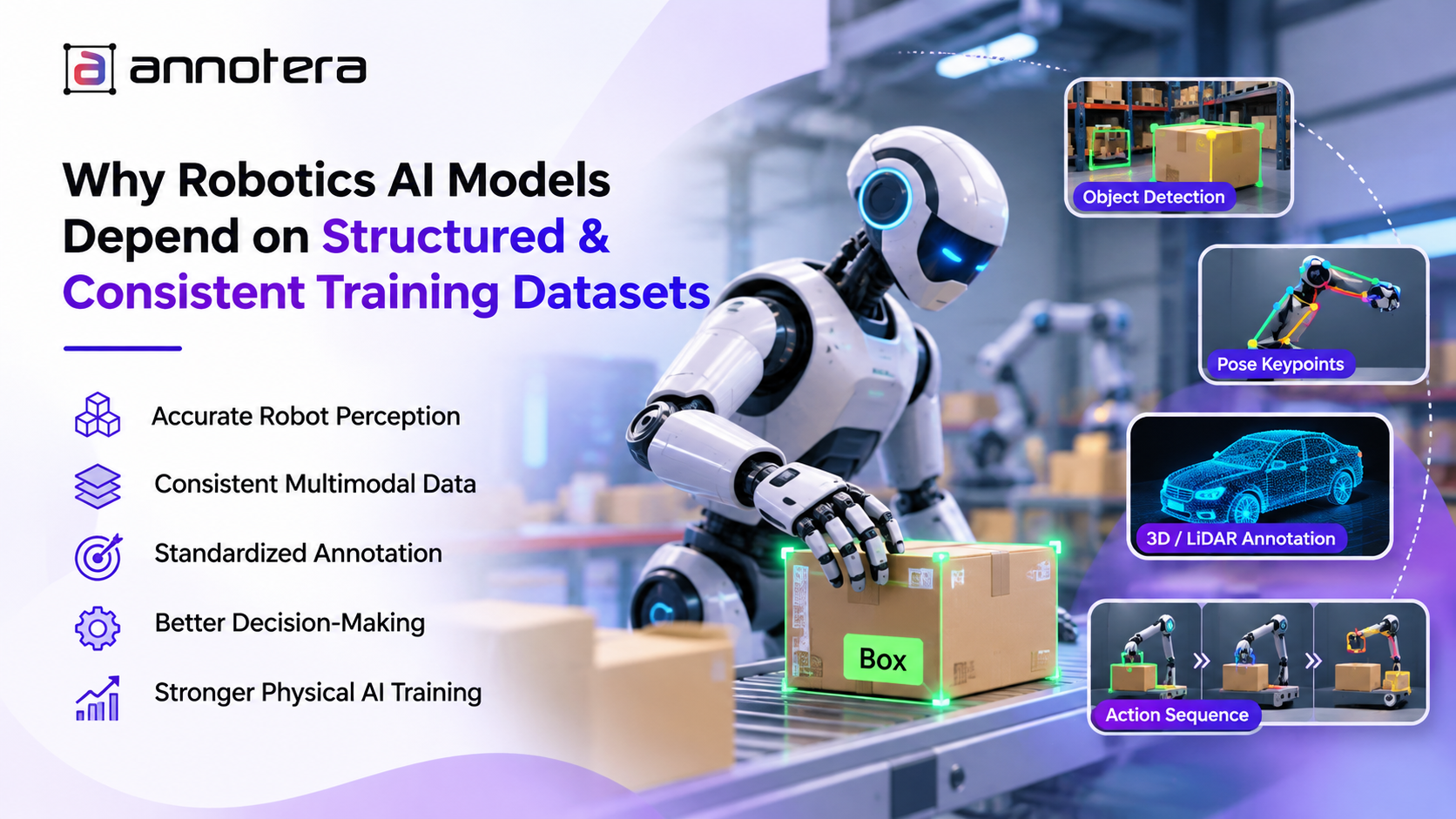

Robotics is entering a new era where intelligent machines are expected to perceive their surroundings, understand instructions, make decisions, and perform complex tasks with minimal human intervention. From autonomous warehouse robots and industrial manipulators to humanoid robots and autonomous mobile systems, modern robotics increasingly depends on AI models capable of learning from real-world experiences.
However, developing intelligent robotic systems requires more than advanced algorithms, powerful processors, or sophisticated hardware. The quality, structure, and consistency of the training datasets play an equally important role in determining how effectively robots learn and operate.
Unlike conventional AI systems that primarily process text or images, robotics AI models must interpret multiple data sources, including camera feeds, LiDAR point clouds, depth information, motion trajectories, sensor readings, and human demonstrations. When these datasets are poorly organized, inconsistently labeled, or missing critical contextual information, models can struggle to learn reliable patterns.
This is why structured training datasets and accurate robotic data annotation services have become essential for advancing Physical AI training and building dependable autonomous robotic systems.
Understanding Structured Training Datasets in Robotics AI
Structured training datasets refer to systematically organized data containing clearly defined labels, metadata, timestamps, categories, and contextual information. These datasets help robotics AI models understand relationships between objects, environments, movements, and actions.
For example, a warehouse robot learning to pick and place packages needs more than images of boxes. Its training dataset should include object boundaries, package orientation, grasping points, spatial coordinates, movement sequences, and relevant environmental conditions.
Similarly, a humanoid robot learning to open a door requires coordinated information about object recognition, hand positioning, joint movements, applied force, and task completion.
A well-structured dataset connects these different elements into a consistent learning framework. It enables AI models to recognize patterns, understand cause-and-effect relationships, and generalize their learning across different environments.
1. Improving Robot Perception and Environmental Understanding
Robots must accurately perceive their surroundings before they can make meaningful decisions. Whether navigating a crowded warehouse or identifying objects on an industrial production line, their perception systems depend on high-quality training data.
Structured datasets help models identify objects, distinguish between environmental elements, recognize obstacles, and understand spatial relationships.
For instance, image annotation can help robots identify products, tools, humans, and obstacles, while 3D point cloud annotation provides information about object dimensions, depth, and positioning.
When annotation guidelines remain consistent across datasets, AI models receive standardized examples that improve their ability to recognize similar objects under changing environmental conditions.
This becomes particularly important when robots encounter variations in lighting, object orientation, background conditions, and environmental complexity.
2. Ensuring Consistency Across Multimodal Sensor Data
Modern robotic systems rarely depend on a single data source. They combine information from cameras, LiDAR, radar, IMUs, depth sensors, and other sensing technologies to understand their surroundings.
However, collecting multimodal data is only the first step. Different sensor streams must be accurately synchronized, aligned, and annotated to create meaningful training datasets.
Consider an autonomous mobile robot approaching an obstacle. Its camera captures the visual appearance, LiDAR measures the obstacle’s distance, and motion sensors provide information about the robot’s movement.
If these data sources contain inconsistent timestamps or mismatched annotations, the model may learn incorrect relationships between perception and movement.
Consistent multimodal annotation helps establish alignment between different sensor modalities. It allows robotics AI models to develop a more comprehensive understanding of their operating environments and make better-informed decisions.
3. Reducing Model Errors Through Standardized Annotation
Inconsistent labeling is one of the major challenges in developing reliable robotics AI models.
For example, if different annotators classify the same object using different labels, the model may receive conflicting training signals. Similarly, inconsistent definitions of object boundaries, movement categories, or action sequences can reduce dataset reliability.
Standardized annotation guidelines address these problems by defining clear labeling rules, classification categories, and quality requirements.
Professional robotic data annotation services support this process through structured workflows, trained annotation teams, validation procedures, and quality assurance mechanisms.
Inter-annotator agreement, multi-level reviews, and predefined annotation taxonomies help maintain consistency across large-scale datasets.
As a result, robotics developers can minimize labeling discrepancies, improve training reliability, and build models that perform more predictably in real-world applications.
4. Supporting Better Decision-Making and Action Execution
Robotics AI models must do more than recognize objects. They must translate environmental information into appropriate physical actions.
For example, a robotic arm performing an object-picking task needs to determine:
-
Which object should be selected?
-
Where is the object positioned?
-
What is the safest grasping approach?
-
How much force should be applied?
-
What movement sequence will complete the task?
Structured datasets containing perception labels, action sequences, trajectory information, and task outcomes help models learn these relationships.
Consistent demonstrations also allow robots to understand how successful actions differ from unsuccessful ones.
This is particularly valuable for imitation learning, reinforcement learning, and vision-language-action models, where models learn from demonstrations, feedback, and interactions with physical environments.
Better-organized training examples can improve action prediction, reduce unnecessary movements, and support more reliable task execution.
5. Strengthening Physical AI Training and Real-World Adaptability
Physical AI focuses on developing intelligent systems that interact with and operate within the physical world. Unlike purely digital AI applications, these systems must account for real-world constraints such as gravity, friction, object weight, movement limitations, and changing environmental conditions.
Consequently, Physical AI training requires datasets that represent not only what robots see but also how they interact with their surroundings.
For example, a humanoid robot learning to lift an object needs training examples containing object properties, grasping positions, joint movements, force feedback, and task outcomes.
Structured datasets make it easier to connect perception, reasoning, and physical actions.
They also support the inclusion of diverse scenarios, including unexpected obstacles, unusual object configurations, failed attempts, and environmental variations.
Such diversity helps models develop stronger generalization capabilities instead of memorizing a limited set of training situations.
6. Enabling Scalable Dataset Management and Model Improvement
Robotics development involves continuous data collection, annotation, model training, testing, and refinement. As robotic systems become more sophisticated, dataset volumes and complexity increase significantly.
Without proper dataset organization, managing multiple annotation versions, tracking errors, and identifying training gaps becomes increasingly difficult.
Structured datasets support better data governance through:
-
Consistent metadata: Organizing information by sensor type, environment, task, and collection conditions.
-
Dataset versioning: Tracking changes in labels, annotation guidelines, and training samples.
-
Quality monitoring: Identifying incomplete annotations, duplicate records, and inconsistent labels.
-
Scenario coverage: Identifying underrepresented situations that require additional data collection.
-
Traceability: Connecting training examples with their original data sources and annotation histories.
These practices help robotics teams maintain reliable datasets throughout the model development lifecycle while supporting continuous improvement.
How Annotera Supports High-Quality Robotics Training Data
At Annotera, we recognize that intelligent robotic systems depend on reliable data foundations. Our data annotation capabilities help AI developers transform complex raw datasets into structured, consistent, and model-ready training resources.
Our approach focuses on supporting diverse robotics requirements through image annotation, video annotation, 3D point cloud labeling, object tracking, keypoint annotation, and multimodal data annotation.
We emphasize standardized annotation guidelines, quality validation, and consistency across datasets to help robotics teams address complex perception and learning challenges.
Whether developing autonomous navigation systems, robotic manipulation solutions, or humanoid robots, Annotera helps organizations strengthen their data pipelines with annotation workflows designed around specific AI training requirements.
Conclusion
The performance of robotics AI models depends not only on algorithmic innovation but also on the quality and consistency of the data used to train them. Structured datasets provide the foundation for accurate perception, coordinated sensor understanding, intelligent decision-making, and reliable physical interactions.
As robotics evolves toward increasingly autonomous and adaptable systems, investing in standardized annotation processes and well-organized training data will become even more important.
For organizations developing next-generation robotic applications, partnering with an experienced data annotation provider can help improve dataset reliability, streamline model development, and accelerate innovation.
Build Smarter Robots with Better Training Data.
Partner with Annotera to transform complex robotic datasets into structured, high-quality training resources. Explore our robotic data annotation services and strengthen your foundation for next-generation Physical AI.