Physical Address
304 North Cardinal St.
Dorchester Center, MA 02124
Physical Address
304 North Cardinal St.
Dorchester Center, MA 02124

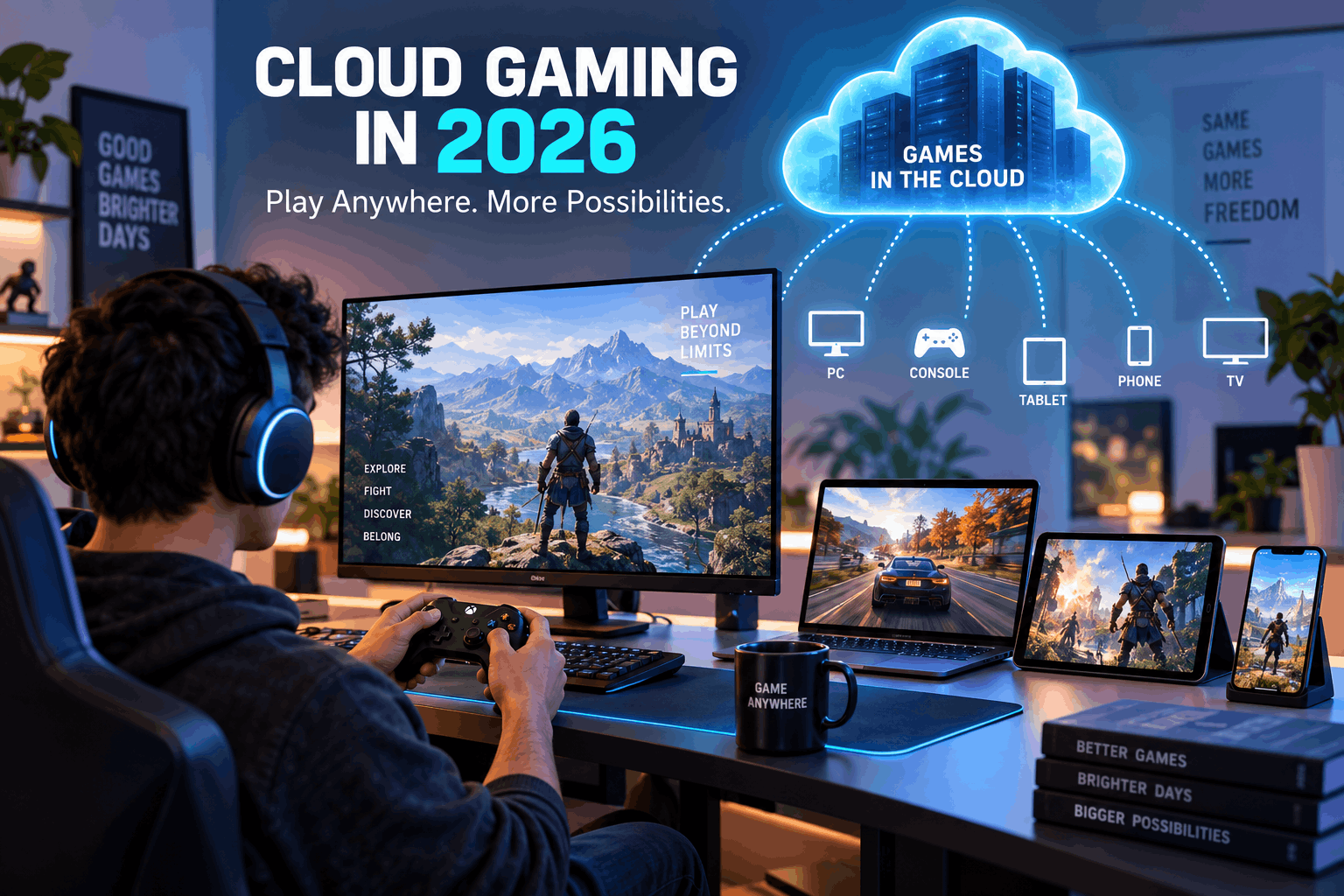
Gaming no longer depends entirely on having a powerful PC or the latest console. Cloud gaming has changed the way people access and play games by moving much of the hardware-intensive work to remote servers. Instead of running a demanding game directly on your device, the game is processed in the cloud and streamed to your screen over the internet.
As internet connections continue to improve, cloud gaming has become a more practical option for players who want to enjoy modern games without investing in expensive hardware. But how does cloud gaming actually work, and is it worth trying in 2026?
Cloud gaming is a way of playing video games where the game runs on a remote server rather than directly on your computer, phone, or other personal device.
When you start a game, the remote server handles tasks such as rendering graphics and processing the game. The resulting video is streamed to your device, while your controller, keyboard, mouse, or touchscreen sends your inputs back to the server.
The experience is similar to watching a video stream, except that it is interactive. Every movement, button press, and command needs to travel between your device and the remote server quickly enough for the game to respond.
This means you may not need a high-end graphics card or a powerful gaming PC. Your device mainly needs to receive the video stream and send your controls back to the server.
The process involves several important steps.
First, you connect your device to a cloud gaming service through the internet. Depending on the service, you may be able to play through a browser, an application, or a supported gaming device.
The selected game then runs on a remote computer in a data center. That computer has the hardware necessary to render the game.
The server sends the resulting video and audio to your device. At the same time, your inputs are transmitted back to the server. The server processes those commands and sends an updated video stream back to you.
This entire process happens continuously while you play.
Because of this two-way communication, latency is one of the most important factors in cloud gaming. A fast connection is useful, but the physical distance between you and the gaming server and the quality of the network connection also matter.
One of the biggest attractions of cloud gaming is that the hardware requirements on the player’s side can be relatively modest.
However, that does not mean you can play smoothly with any internet connection.
A stable broadband or high-quality mobile connection is important. Connection speed, latency, network stability, and congestion can all affect the experience.
A wired Ethernet connection can sometimes provide a more consistent experience than Wi-Fi. If you use Wi-Fi, staying reasonably close to the router and using a modern wireless standard can help reduce connection problems.
Your display also matters. A larger, higher-resolution screen can make streamed games look better, but it can also increase the amount of data that needs to be delivered.
The most obvious benefit is reduced dependence on powerful local hardware. Since the game is rendered remotely, you may be able to play demanding titles on a device that would struggle to run them locally.
For players who do not want to build or upgrade a gaming PC, this can make modern gaming more accessible.
Cloud gaming can make it easier to switch between supported devices. Depending on the service, you might play on a computer, television, tablet, phone, or another compatible device.
This flexibility is useful for people who do not always want to sit at a traditional gaming desk.
Traditional games can require large downloads and significant storage space. With cloud gaming, much of the game itself remains on the remote server.
That can be useful if your device has limited storage capacity.
A capable cloud server can provide hardware that would otherwise be expensive to purchase. This gives some players access to visually demanding games without buying a high-end graphics card or upgrading their entire system.
Cloud gaming is not perfect, and its biggest limitations are related to internet connectivity.
Traditional gaming can often continue without an internet connection, depending on the game. Cloud gaming generally requires a stable connection throughout the session.
If your connection becomes unstable, you may experience lower image quality, pauses, or disconnections.
Every command has to travel from your device to the server and back. Even a small delay can become noticeable in fast-paced games.
This is especially important for competitive shooters, fighting games, racing games, and other titles where precise timing matters.
Unlike a locally rendered game, the quality of a cloud stream can change depending on network conditions.
If bandwidth becomes limited or the connection becomes unstable, the service may reduce video quality to maintain the connection.
Cloud gaming can reduce the need for expensive hardware, but it does not necessarily make gaming free. Depending on the service and game, you may need to pay for a subscription, purchase individual games, or use another pricing model.
It is therefore important to compare the total cost with your existing gaming setup.
Traditional gaming gives you direct control over the hardware running the game. A powerful PC or console can provide consistent performance without relying on continuous game streaming.
Cloud gaming takes a different approach. Instead of purchasing and maintaining expensive hardware, you rely on remote computing resources.
For casual players, people with limited hardware, or gamers who value flexibility, cloud gaming can be attractive.
For competitive players who prioritize the lowest possible latency and maximum image quality, local gaming may still be preferable.
Neither approach is automatically better. The right choice depends on your hardware, internet connection, budget, and the types of games you enjoy.
For many players, yes—but expectations should be realistic.
Cloud gaming has become considerably more practical as internet infrastructure and streaming technology have improved. It can be particularly appealing if you already have a reliable internet connection but do not own a powerful gaming PC.
It can also be useful as a secondary gaming option. For example, someone with a desktop gaming PC might use cloud gaming when travelling or when playing on a device with limited hardware.
However, cloud gaming may not be the best choice for everyone. If you already own a powerful PC or console and are highly sensitive to input latency, traditional gaming may still provide a better experience.
The most practical approach is to try a suitable cloud gaming service with a reliable connection before deciding whether it deserves to replace your existing setup.
Cloud gaming is likely to remain an important part of the gaming industry. Improvements in broadband networks, data centers, streaming technology, and network infrastructure can continue to reduce some of the limitations associated with remote gaming.
At the same time, local gaming hardware is also becoming more capable. This means cloud gaming does not necessarily have to replace gaming PCs and consoles.
Instead, the future may involve a combination of local and cloud-based gaming, giving players more choices about where and how they access their games.
Cloud gaming in 2026 offers an interesting alternative to traditional gaming. It can reduce the need for expensive hardware, save local storage, and make games accessible across a wider range of devices.
However, the quality of the experience depends heavily on internet stability, latency, server location, and the service being used.
For casual and flexible gaming, cloud gaming is certainly worth trying. For competitive players and hardware enthusiasts, a traditional PC or console may still be the better choice.
Ultimately, cloud gaming is not about completely replacing traditional gaming. Its biggest advantage is giving players another way to enjoy games—without making powerful local hardware the only path to a good gaming experience.